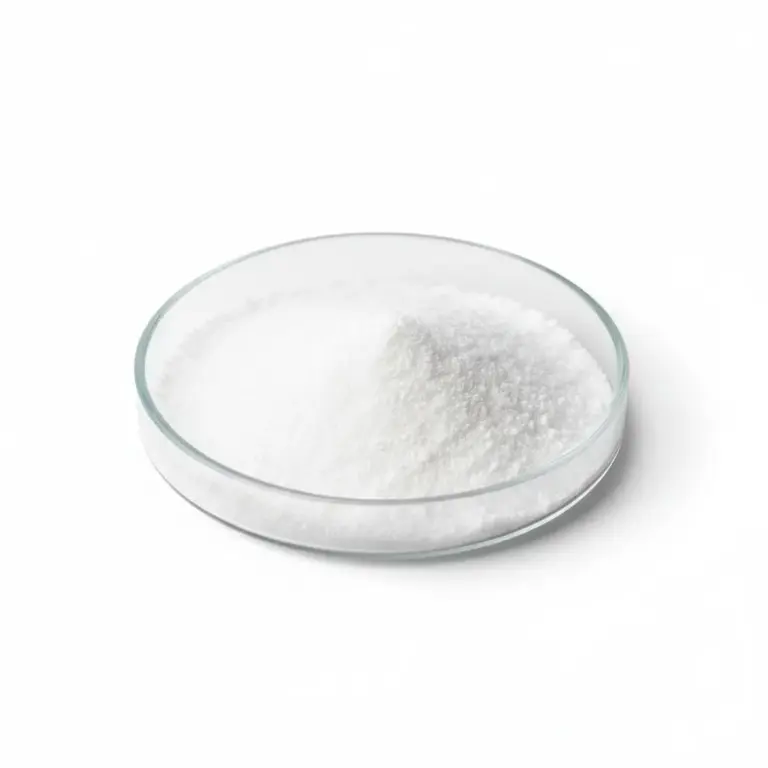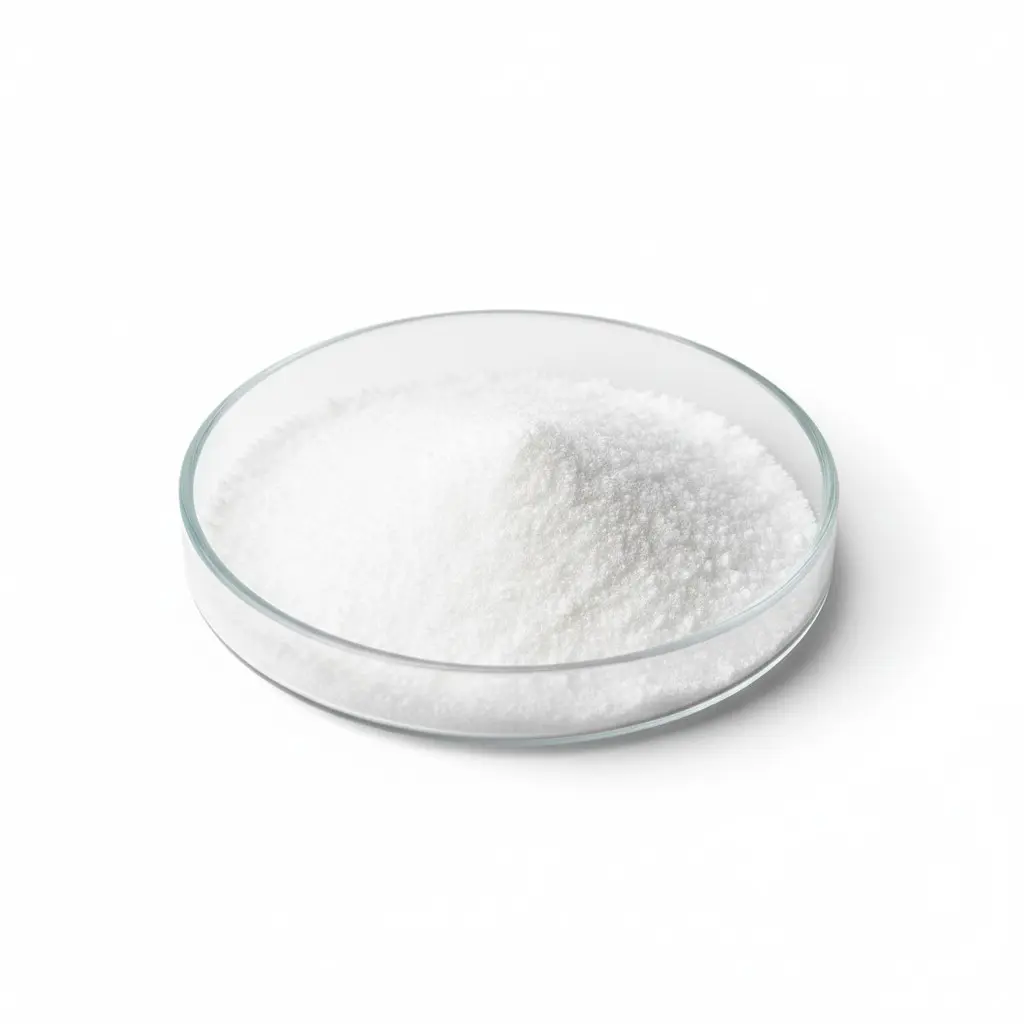

Search for hyaluronic acid powder and you will find two names on spec sheets: hyaluronic acid and sodium hyaluronate. Buyers often ask whether they are different ingredients, and which one to order. The short answer: they are the same polymer in two forms, and the form that is actually sold as a powder is almost always sodium hyaluronate.
What hyaluronic acid is
Hyaluronic acid, also called hyaluronan, is a long, unbranched sugar chain. It is a glycosaminoglycan built from one repeating unit: D-glucuronic acid linked to N-acetyl-D-glucosamine. Unlike chondroitin sulfate, it carries no sulfate groups. A single chain can contain thousands of these units, which is why grades are described by molecular weight.
Each glucuronic acid unit has a carboxyl group. In water near neutral pH, that group gives up its proton, so the chain exists as a negatively charged hyaluronate with a positive ion alongside it.
What sodium hyaluronate is
Sodium hyaluronate is that same chain with sodium as the counter-ion. Producers isolate the polymer in this salt form because it is the practical way to obtain a stable, water-soluble powder. So when a supplier lists “hyaluronic acid powder”, the specification usually reads sodium hyaluronate.
Side-by-side
| Hyaluronic acid | Sodium hyaluronate | |
|---|---|---|
| What it is | The polymer in its acid form | The sodium salt of the same polymer |
| CAS number | 9004-61-9 | 9067-32-7 |
| INCI name | Hyaluronic Acid | Sodium Hyaluronate |
| Commercial powder | Rarely supplied as the free acid | The usual form of “HA powder” |
| Grade defined by | Molecular weight, purity and source — not by the name | |
Is one better than the other?
Not in itself. Once dissolved, both give the same hyaluronate chain in solution. What changes performance is molecular weight. Long chains build viscosity and leave a water-holding film on the skin surface. Short chains give thin solutions. A 2025 review of topical use reports that HA below about 100 kDa can penetrate skin, and that lower molecular weights can reach the dermis. [1]
A small trial shows the practical effect. In 36 elderly people with dry skin, a lotion with low molecular weight HA raised skin hydration more than a lotion with high molecular weight HA after four weeks. [2] That is a difference between two grades of the same material, not between “acid” and “salt”. Our molecular weight guide covers how to compare grades.
Related INCI names you will see
- Sodium Hyaluronate — the standard salt form.
- Hyaluronic Acid — the acid form; some brands use it on labels even when the raw material is the salt.
- Hydrolyzed Hyaluronic Acid and Hydrolyzed Sodium Hyaluronate — chains broken down to low molecular weight.
- Sodium Acetylated Hyaluronate and Sodium Hyaluronate Crosspolymer — chemically modified derivatives.
Use the INCI name that matches the material on your specification. If you buy sodium hyaluronate, declare Sodium Hyaluronate.
What this means on the COA
The assay can be reported on different bases: as sodium hyaluronate, as hyaluronic acid, or as glucuronic acid. The sodium salt weighs more than the acid chain alone, so the same material gives different numbers on each basis. When you compare two offers, check that the assay basis and the method are the same. Then compare molecular weight or intrinsic viscosity, protein content, loss on drying and the microbiological profile.
Quick answers
Is sodium hyaluronate the same as hyaluronic acid? It is the same polymer. Sodium hyaluronate is the salt form, and it is what most HA powders are.
Which one should I put on my label? The one on your raw-material specification. For most powders that is Sodium Hyaluronate.
Does the salt form work differently in the body? In solution both give hyaluronate. Molecular weight and dose are what studies compare. See oral hyaluronic acid research and what hyaluronic acid does.
What the research says
- A 2025 review of topical hyaluronic acid reports that HA below about 100 kDa penetrates skin, with lower molecular weights able to reach the dermis. It also notes that the safety of HA-containing formulations has been evaluated in several clinical trials. [1]
- In a 4-week double-blind trial in 36 elderly people with dry skin, low molecular weight HA lotion raised skin hydration more than high molecular weight HA lotion or the plain lotion. Water loss and symptom scores did not differ. [2]
These summaries describe published research on the ingredient. They are not claims for any finished product; claims on finished products must meet the rules of the market where they are sold.
References
- Zanchetta C, et al. Hyaluronic acid in topical applications: the various forms and biological effects of a hero molecule in the cosmetics industry. Biomolecules. 2025;15(12):1656. doi:10.3390/biom15121656
- Muhammad P, et al. Effectiveness of topical hyaluronic acid of different molecular weights in xerosis cutis treatment in elderly: a double-blind, randomized controlled trial. Arch Dermatol Res. 2024;316(6):329. doi:10.1007/s00403-024-03003-2
Sourcing sodium hyaluronate?
FC Materials supplies hyaluronic acid powder to supplement and personal-care manufacturers in Malaysia. Tell us your application and target molecular weight, and our team will send the specification, COA and pricing.