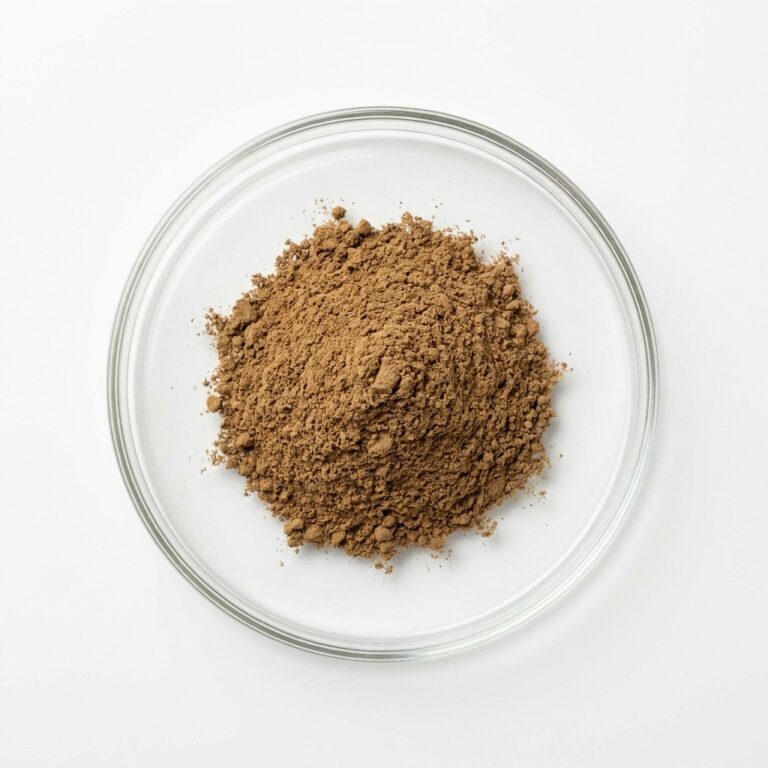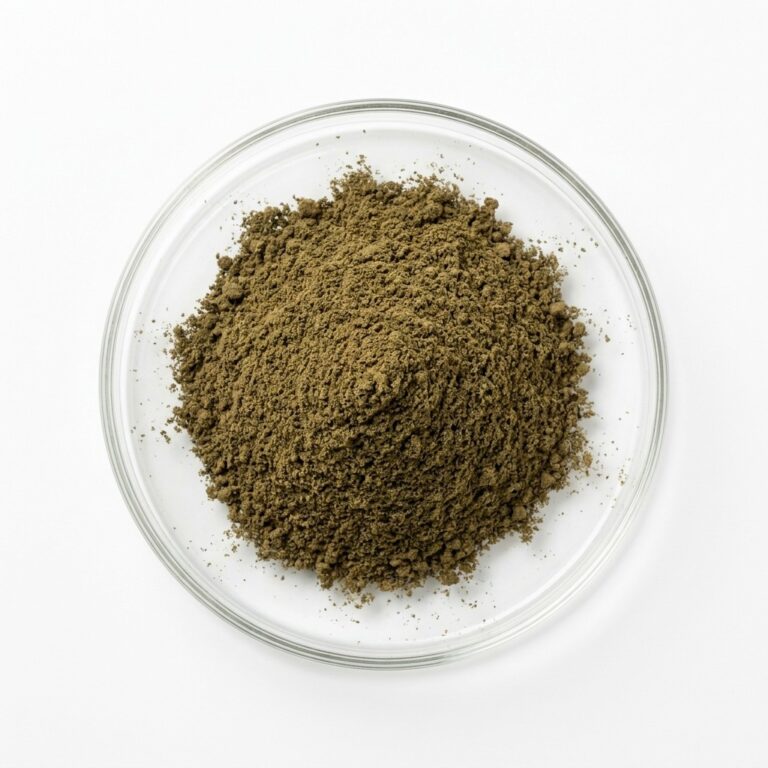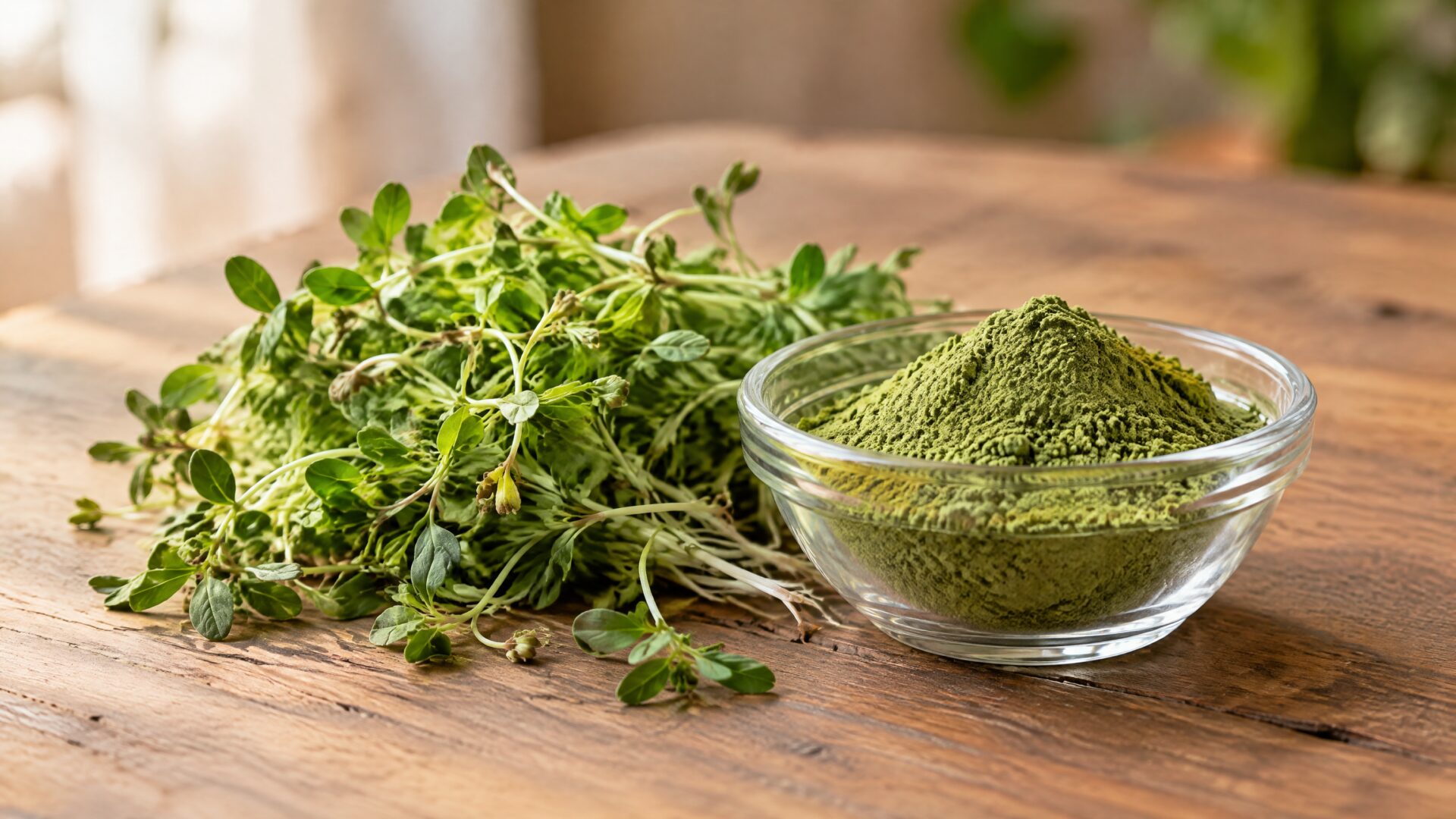

Alfalfa (Medicago sativa), also called lucerne, is best known as animal fodder. Its dried leaves and extracts are also sold as supplement ingredients, usually in green powder blends. This guide explains what alfalfa contains and what human research actually shows. It also covers safety and what to ask for on a certificate of analysis.
What Is Alfalfa?
Alfalfa is a perennial legume grown worldwide as hay and forage. For supplements, the dried aerial parts (leaves and stems) are milled into a powder or extracted. A 2011 review lists its main compounds as saponins, flavonoids, phytoestrogens, coumarins, alkaloids, amino acids, phytosterols, vitamins, enzymes and terpenes [2].
The plant has a long history in traditional medicine in China, India, Iraq, Turkey and America [2]. Traditional use, however, is not the same as evidence from human trials. That gap matters for alfalfa, as the research section below shows.
Alfalfa Leaf, Extract, Protein Concentrate, Seeds or Sprouts?
“Alfalfa” on a label can mean several quite different materials. Buyers should know which one they are getting:
- Leaf powder: the dried, milled aerial parts. Green, grassy and low in concentrated actives.
- Extract (for example 10:1): made from the aerial parts with a solvent, then dried. A ratio such as 10:1 describes the amount of starting plant, not the content of any compound. FC Materials supplies an alfalfa extract (10:1) made from the dried aerial parts.
- Leaf protein concentrate: a pressed-juice protein product. In the EU it is authorised for food supplements with a defined specification of 45–60% protein [6].
- Seeds and sprouts: eaten as food, mainly as raw sprouts in salads. They carry different safety questions from leaf material, covered below.
What the Research Says
Human evidence for alfalfa is thin. A PubMed search in November 2026 found no meta-analysis and no randomised controlled trial of alfalfa leaf or alfalfa extract in people. The studies that do exist are old, small or not about leaf material:
- Cholesterol, seeds only. In a 1987 study, 15 patients with high blood lipids ate 40 g of heat-prepared alfalfa seeds three times a day for 8 weeks. In the type II patients, LDL cholesterol fell by 18% and total cholesterol by 17% [1].
- Limits of that study. There was no control group, the dose was 120 g of seeds a day, and LDL fell by less than 5% in two patients. Body weight rose in the first 4 weeks, and all lipid levels returned to baseline after stopping [1].
- Reviews. A 2011 review lists many effects reported for alfalfa, including cholesterol-lowering, antioxidant and oestrogenic activity. The authors describe its potential as largely unexplored and call for in-depth investigation [2].
These summaries describe published research on the ingredient. They are not claims for any finished product; claims on finished products must meet the rules of the market where they are sold.
In short, there is no good human evidence that an alfalfa supplement improves any health outcome. Claims should stay within its role as a nutritional green ingredient.
Safety: What Buyers Should Know
L-canavanine and lupus-like reactions. Alfalfa contains L-canavanine, an amino acid similar to arginine [3]. Lupus-like autoimmunity was first reported in a volunteer eating alfalfa seed during a cholesterol study. Monkeys fed alfalfa sprouts later developed a lupus-like illness, and L-canavanine was suspected as the cause [3].
A review notes that reports of lupus triggered or worsened by alfalfa tablets are few and remain controversial, and that population studies are sparse [3]. Given this uncertainty, a label advisory for people with lupus or other autoimmune conditions is sensible. The EU specification for leaf protein concentrate limits L-canavanine to 4.5 mg/kg [6].
Vitamin K and blood thinners. Alfalfa is high in vitamin K, so it may affect blood clotting, which depends on vitamin K [4]. This is relevant to people taking warfarin-type anticoagulants. A label advisory is sensible.
Phytoestrogens. Alfalfa contains phytoestrogens, including the coumestan coumestrol [2]. The EU specification caps coumestrol at 100 mg/kg and isoflavones at 350 mg/kg in the protein concentrate [6]. We found no safety studies of alfalfa supplements in pregnancy or breast-feeding, so brands should advise these users to seek medical advice.
Raw sprouts. Sprouted seeds are a recognised food-safety risk because they are usually eaten raw. In 2011, an E. coli outbreak in Europe traced to sprouted seeds caused hundreds of cases of haemolytic uraemic syndrome and several deaths [5]. This concerns fresh sprouts, not dried and tested leaf extracts.
Regulatory Status
In the EU, a leaf protein concentrate from lucerne was authorised in 2009 as a novel food ingredient for food supplements. The European Food Safety Authority concluded it was safe under the specified conditions of use. The daily portion may contain at most 10 g, and the label must name it as lucerne or alfalfa protein [6].
That decision covers one defined product, not every alfalfa extract. In Malaysia, the right route depends on the product category and its claims. Our FC | Comply team can advise on the NPRA or food-regulation documents you need.
What to Check Before You Buy
- Plant part. Medicago sativa aerial parts, not seed or sprout. The lupus reports and animal studies involved seeds, sprouts or tablets [3].
- Extraction details. Extraction ratio, solvent, and any carrier with its percentage.
- Marker content. If a compound is specified, the test method. A ratio alone does not guarantee any content.
- Identity. A TLC or HPLC fingerprint against a reference.
- Contaminants. Loss on drying, heavy metals (lead, arsenic, cadmium, mercury) and pesticide residues. Alfalfa is a field crop, so residues matter.
- Microbiology. Total plate count, yeast and mould, E. coli and Salmonella.
- Optional checks. L-canavanine and coumestrol, if the supplier can test them. The EU limits for leaf protein concentrate are a useful benchmark [6].
- Documents. Halal certificate, batch number, manufacture and retest dates.
Alfalfa is often blended with other green ingredients such as chlorella extract and moringa extract. Chlorophyll fades with light and heat, so expect some colour change over shelf life.
Frequently Asked Questions
What is alfalfa used for in supplements?
Mainly as a green nutritional ingredient in capsules, tablets and powder blends. Human trials have not shown a clear health benefit for alfalfa leaf or extract [1][2].
Is alfalfa the same as lucerne?
Yes. Lucerne is another common name for alfalfa, Medicago sativa. EU law uses both names [6].
Are alfalfa sprouts the same as alfalfa extract?
No. Sprouts are germinated seeds eaten raw. They contain L-canavanine and carry a food-safety risk from bacteria [3][5]. Supplement extracts are usually made from the dried leaves and stems.
Who should be careful with alfalfa?
People with lupus or other autoimmune conditions, people taking warfarin-type blood thinners, and women who are pregnant or breast-feeding should seek medical advice first [3][4].
What alfalfa grade does FC Materials supply?
Our Alfalfa Extract is a 10:1 extract of the dried aerial parts and is Halal-certified. Ask us for the specification and certificate of analysis.
References
- Mölgaard J, von Schenck H, Olsson AG. Alfalfa seeds lower low density lipoprotein cholesterol and apolipoprotein B concentrations in patients with type II hyperlipoproteinemia. Atherosclerosis. 1987;65(1-2):173-9. doi:10.1016/0021-9150(87)90019-0
- Bora KS, Sharma A. Phytochemical and pharmacological potential of Medicago sativa: a review. Pharm Biol. 2011;49(2):211-20. doi:10.3109/13880209.2010.504732
- Akaogi J, Barker T, Kuroda Y, et al. Role of non-protein amino acid L-canavanine in autoimmunity. Autoimmun Rev. 2006;5(6):429-35. doi:10.1016/j.autrev.2005.12.004
- Mousa SA. Antithrombotic effects of naturally derived products on coagulation and platelet function. Methods Mol Biol. 2010;663:229-40. doi:10.1007/978-1-60761-803-4_9
- Sarno E, Pezzutto D, Rossi M, et al. A review of significant European foodborne outbreaks in the last decade. J Food Prot. 2021;84(12):2059-70. doi:10.4315/JFP-21-096
- European Commission. Commission Decision 2009/826/EC of 13 October 2009 authorising the placing on the market of a leaf extract from Lucerne (Medicago sativa) as novel food or novel food ingredient. OJ L 294, 11.11.2009, p. 12-13. EUR-Lex.
Source it from FC Materials: Alfalfa extract (10:1) – specification, COA and Halal documents on request.
Sourcing alfalfa extract for your formulation?
FC Materials supplies alfalfa extract (10:1) to supplement and functional food manufacturers. Tell us your product needs and our team will respond with specs, pricing and MOQ.