
Ashwagandha is one of the most studied herbal supplements in the world, and one of the fastest-rising searches in Malaysia. This guide sets out what the clinical evidence shows for stress, sleep, cortisol and testosterone, where the results are mixed, what is known about safety, and what manufacturers should check when buying ashwagandha extract. For the full safety picture, see ashwagandha side effects.
What is ashwagandha?
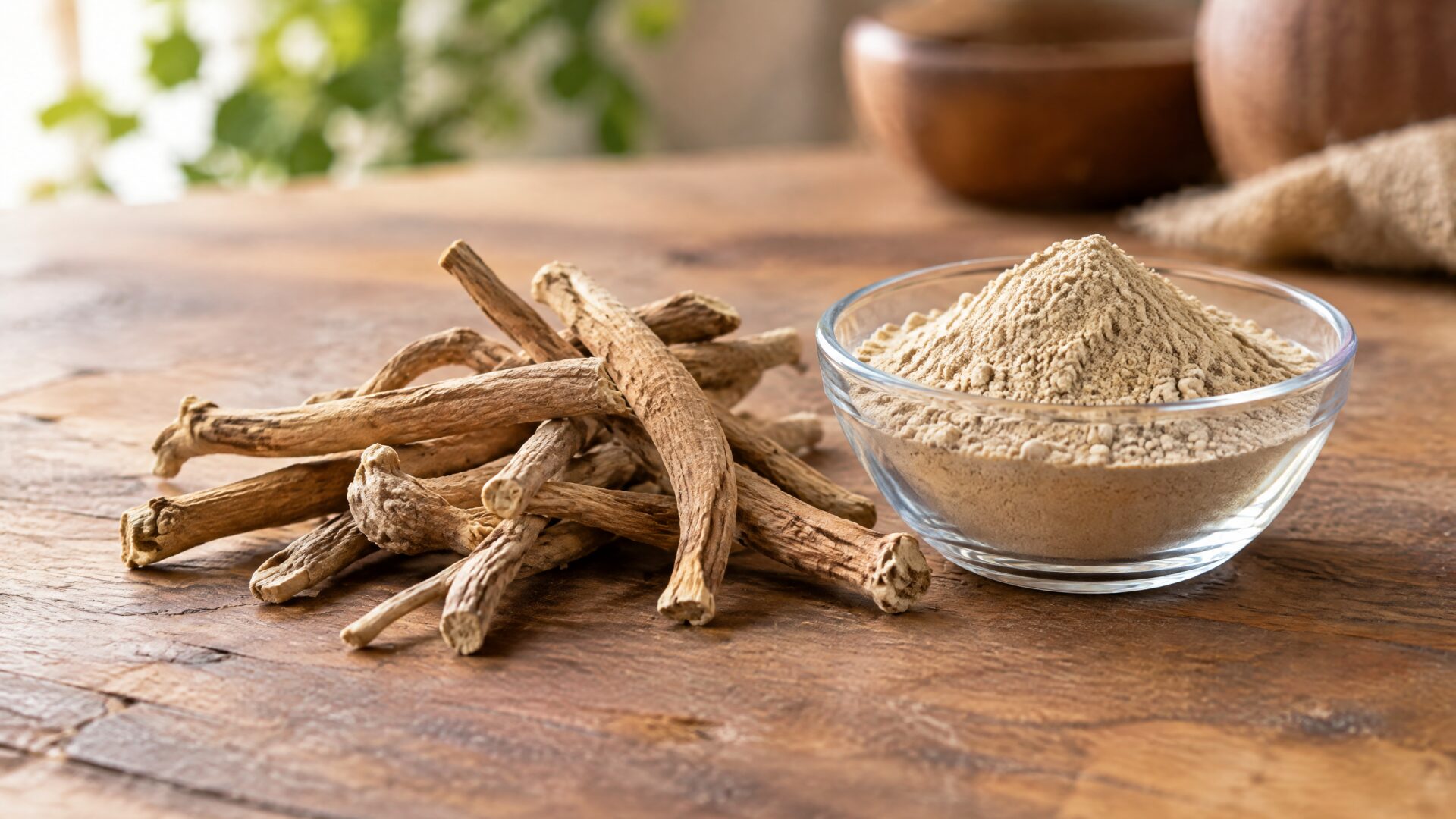
Ashwagandha (Withania somnifera) is a small shrub in the nightshade family, native to India, the Middle East and parts of Africa. It has been used in Ayurvedic medicine for centuries and is often called Indian ginseng or winter cherry, although it is not related to true ginseng. It is usually described as an adaptogen: a herb used to help the body cope with stress.
The root is the part traditionally used. Its main active compounds are withanolides, a group of steroidal lactones that includes withanolide A and withaferin A. Supplements contain either root powder or, more often, an extract with a stated withanolide content.
Ashwagandha benefits: what the research shows
Stress and anxiety
This is the best-studied use. A 2022 meta-analysis of 12 randomised trials (1,002 adults aged 25–48) found that ashwagandha lowered anxiety and stress scores compared with placebo. The benefit for stress appeared at 300–600 mg a day. The authors rated the certainty of the evidence as low for both outcomes, and results varied widely between trials. [1]
A 2024 meta-analysis of 9 randomised trials (558 patients) found lower scores on the Perceived Stress Scale and the Hamilton Anxiety Scale, and lower blood cortisol, compared with placebo. Four of the trials reported mild to moderate side effects, and the authors note that long-term safety is not yet known. [2]
Cortisol versus feeling less stressed
The results are not uniform. A 2025 meta-analysis (488 participants) found that ashwagandha lowered cortisol by about 1.16 µg/dL but had no significant effect on perceived stress scores. The authors suggest that longer trials in more varied groups of people are needed to explain the gap. [3] In other words, a fall in a stress hormone does not always mean people feel less stressed.
Sleep
A 2021 meta-analysis of 5 randomised trials (400 adults), led by researchers in Malaysia, found a small but significant improvement in overall sleep. The effect was larger in adults with insomnia, at doses of 600 mg a day or more, and over 8 weeks or longer. Ashwagandha also improved mental alertness on waking and anxiety, but not quality of life. No serious side effects were reported, but the authors say data on serious side effects are limited. [4]
A 2024 meta-analysis of 5 trials (254 patients with anxiety or insomnia) found shorter time to fall asleep, longer total sleep time, better sleep efficiency and better sleep-quality scores, but no change in time awake during the night. The trials varied greatly, and the authors call for larger studies. [5]
Ashwagandha benefits for men: testosterone
A 2026 meta-analysis of 23 randomised trials (1,706 adults) found that ashwagandha raised testosterone in men by about 57 ng/dL compared with placebo. It also lowered cortisol and did not change oestradiol. The authors note that the trials were varied and that some hormone results rest on limited data. [6]
Ashwagandha for women
In the same hormone meta-analysis, ashwagandha did not change testosterone or oestradiol in women. [6] We found no review that reports stress or sleep results for women separately. Women who are pregnant, trying to conceive or breastfeeding should read the pregnancy section of our safety guide before using ashwagandha.
Thyroid hormones
The hormone meta-analysis found that ashwagandha raised the thyroid hormone T4 slightly (about 0.61 µg/dL), with no change in TSH or T3. [6] This is small, but it matters for people with thyroid conditions or on thyroid medicine.
Energy, strength and memory
These uses are widely marketed. This guide does not yet summarise the evidence for them, so we make no claim either way.
How much ashwagandha was used in the studies?
Trials used different extracts and doses. The stress meta-analysis found its benefit at 300–600 mg a day [1], and the sleep meta-analysis found larger effects at 600 mg a day or more for at least 8 weeks [4]. Products differ a lot in withanolide content, so the same number of milligrams does not mean the same dose from one product to the next. Follow the label and ask a doctor or pharmacist if you take other medicines.
Is ashwagandha safe?
Most people in trials had no serious side effects, and reported side effects were usually mild. [2][4] But ashwagandha has been linked to rare cases of liver injury, usually after several weeks of use. Most people recovered after stopping, but people with existing liver disease have had severe outcomes. [7] Read our full guide to ashwagandha side effects and who should avoid it.
Khasiat ashwagandha (Bahasa Melayu)
Ashwagandha (Withania somnifera) ialah herba dalam perubatan Ayurveda yang juga dikenali sebagai “Indian ginseng”. Bahagian yang biasa digunakan ialah akarnya. Kajian klinikal mendapati ia boleh mengurangkan skor tekanan dan keresahan, menurunkan paras hormon kortisol dan sedikit meningkatkan kualiti tidur, terutamanya bagi orang dewasa yang mengalami insomnia. [1][4] Pada lelaki, ia meningkatkan paras testosteron, tetapi tidak mengubah paras testosteron pada wanita. [6]
Namun, tahap kepastian bukti masih rendah. Ashwagandha juga pernah dikaitkan dengan kes kecederaan hati, walaupun jarang berlaku. [7] Elakkan pengambilan jika anda hamil, menyusukan anak atau mempunyai penyakit hati, dan dapatkan nasihat doktor jika anda sedang mengambil ubat. Baca juga kesan sampingan ashwagandha (dalam bahasa Inggeris).
For manufacturers: what to check when buying ashwagandha extract
Two products can both be called “ashwagandha extract” and still differ greatly. Before you compare offers, ask for:
- Plant part: root only, or root and leaf. Leaf has a different withanolide profile and is not accepted in some markets.
- Withanolide content and method: gravimetric and UV methods give higher percentages than HPLC, which measures named withanolides. An extraction ratio such as 10:1 is not a withanolide figure.
- Identity test: HPTLC fingerprint or microscopy to confirm Withania somnifera.
- Contaminants: heavy metals (lead, arsenic, cadmium, mercury), pesticide residues, residual solvents and microbiology.
- Traceability: batch number, origin and retest date. Better traceability is one of the measures recommended after reports of liver injury. [7]
Rules for ashwagandha differ by market, and some regulators have reviewed or restricted it in food supplements. Check the position in each market before you position a product. FC Materials supplies a root-only ashwagandha extract standardised to 2.5% withanolides by HPLC; see our ashwagandha supply page for the specification, or WhatsApp us.
What the research says
- Stress and anxiety scores fell compared with placebo in two meta-analyses (12 and 9 trials); certainty of evidence was rated low. [1][2]
- Cortisol fell, but perceived stress did not change significantly in a 2025 meta-analysis. [3]
- Sleep improved slightly overall, more in insomnia, at ≥600 mg/day and over ≥8 weeks. [4][5]
- Testosterone rose in men (about 57 ng/dL) but not in women; T4 rose slightly. [6]
- Rare, usually reversible liver injury has been reported, with severe outcomes in people with existing liver disease. [7]
These summaries describe published research on the ingredient. They are not claims for any finished product; claims on finished products must meet the rules of the market where they are sold. This article is not medical advice.
Frequently Asked Questions
What does ashwagandha do to your body?
In trials, ashwagandha lowered stress and anxiety scores and cortisol, and slightly improved sleep. In men it raised testosterone. The certainty of much of this evidence is low.
Does ashwagandha lower cortisol?
Yes, several meta-analyses found lower cortisol than with placebo. One 2025 meta-analysis found that perceived stress did not change significantly, even though cortisol fell.
Does ashwagandha increase testosterone?
A 2026 meta-analysis of 23 trials found about 57 ng/dL higher testosterone in men than with placebo, but no change in women.
Is ashwagandha good for sleep?
A meta-analysis of 5 trials found a small improvement overall, larger in people with insomnia, at 600 mg a day or more, over at least 8 weeks.
Can I take ashwagandha every day?
Trials lasted weeks to a few months, and long-term safety is not established. Rare liver injury has been reported after several weeks of use. Stop and see a doctor if you notice yellowing of the skin or eyes or itching.
Who should not take ashwagandha?
People who are pregnant or breastfeeding, people with liver disease, and anyone with a thyroid condition or taking regular medicine should avoid it or ask a doctor first.
References
- Akhgarjand C, et al. Does Ashwagandha supplementation have a beneficial effect on the management of anxiety and stress? A systematic review and meta-analysis of randomized controlled trials. Phytother Res. 2022;36(11):4115-4124. doi:10.1002/ptr.7598
- Arumugam V, et al. Effects of Ashwagandha (Withania somnifera) on stress and anxiety: a systematic review and meta-analysis. Explore (NY). 2024;20(6):103062. doi:10.1016/j.explore.2024.103062
- Albalawi AA, et al. Dual impact of Ashwagandha: significant cortisol reduction but no effects on perceived stress – a systematic review and meta-analysis. Nutr Health. 2025;31(4):1395-1408. doi:10.1177/02601060251363647
- Cheah KL, et al. Effect of Ashwagandha (Withania somnifera) extract on sleep: a systematic review and meta-analysis. PLoS One. 2021;16(9):e0257843. doi:10.1371/journal.pone.0257843
- Fatima K, et al. Safety and efficacy of Withania somnifera for anxiety and insomnia: systematic review and meta-analysis. Hum Psychopharmacol. 2024;39(6):e2911. doi:10.1002/hup.2911
- Fornalik M, et al. Hormonal modulation with Withania somnifera: systematic review and meta-analysis of randomized-controlled trials. Planta Med. 2026;92(8):790-805. doi:10.1055/a-2802-8363
- McIntyre D, et al. Ashwagandha (Withania somnifera)-associated liver injury: a scoping review of clinical characteristics and safety considerations. Cureus. 2026;18(5):e109764. doi:10.7759/cureus.109764
Sourcing ashwagandha extract?
FC Materials supplies ashwagandha extract to supplement manufacturers in Malaysia and Southeast Asia. Tell us your format and volume, and we will send the specification and COA.