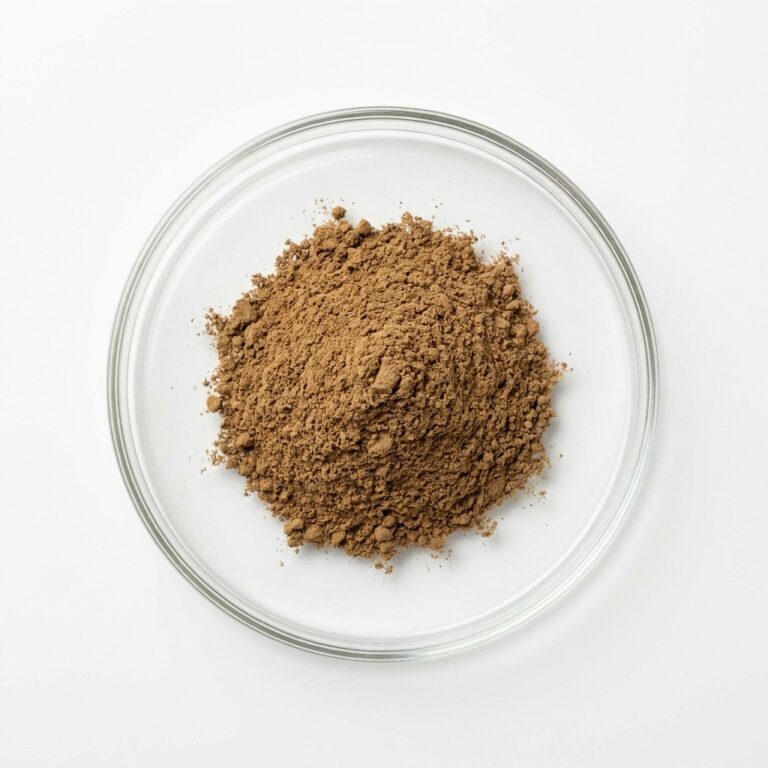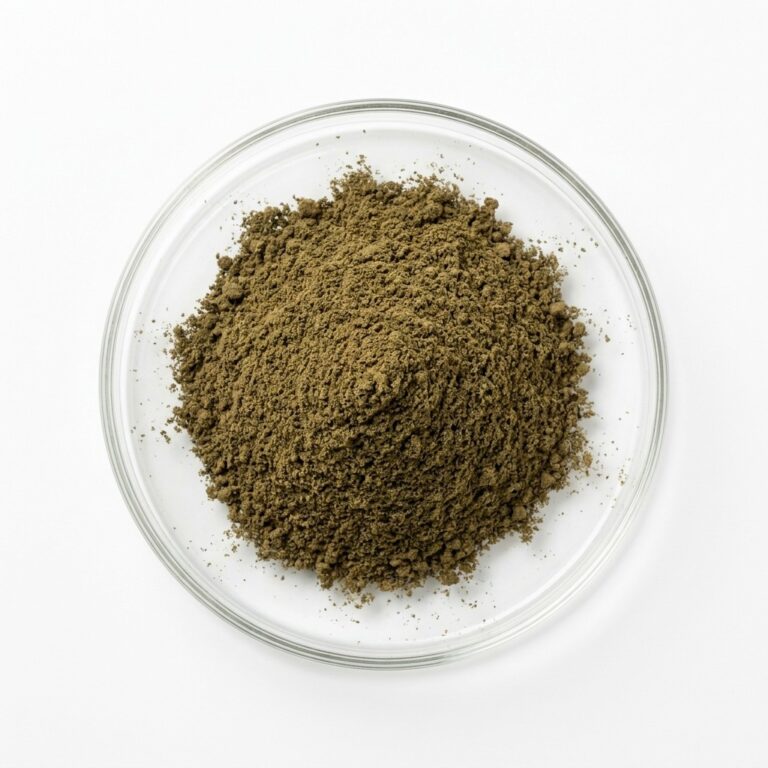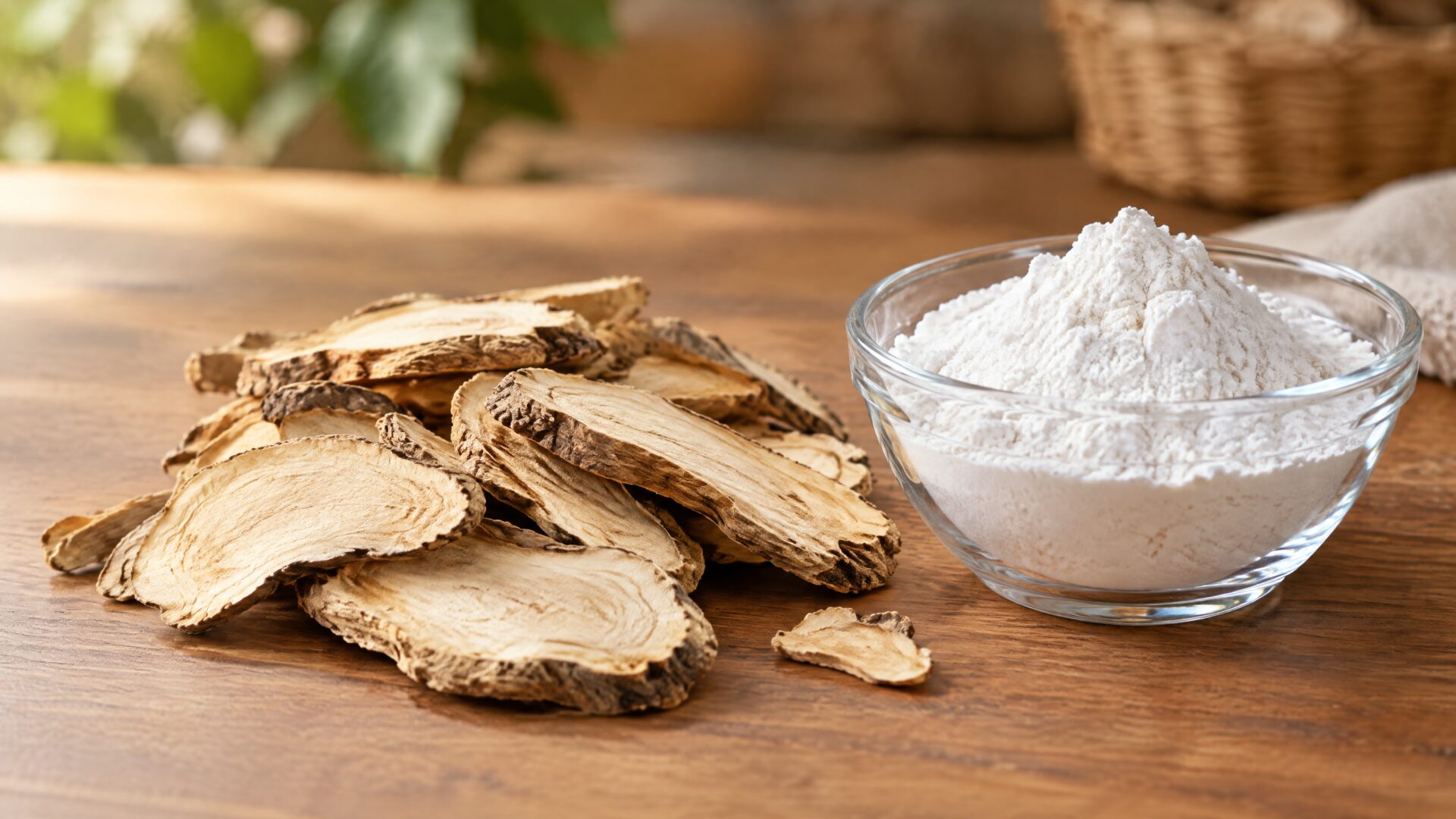

Kudzu is the common name for Pueraria lobata, a climbing vine. Its root has a long history in Chinese herbal practice, where it is called Ge Gen. In Malaysia it is sometimes searched as akar kudzu. Today the root is sold mainly as a standardised extract rich in isoflavones. This guide explains what kudzu root extract contains, how it differs from Pueraria mirifica, what the limited human research shows, and what to check before you buy.
What Is Kudzu Root Extract?
Kudzu root extract is a concentrated powder made from the root of Pueraria lobata. Its main compounds are isoflavones, chiefly puerarin, daidzin and daidzein. Isoflavones are plant compounds with weak oestrogen-like activity, which is why they are called phytoestrogens.
Extracts are sold against a stated isoflavone or flavonoid content. FC Materials supplies Pueraria Lobata Extract from kudzu root, standardised to more than 40% flavonoids (UV).
Kudzu Is Not Pueraria Mirifica
The two plants share a genus and part of a name, and they are often confused online. They are different ingredients.
- Pueraria lobata (kudzu, Ge Gen): its main isoflavones are puerarin, daidzin and daidzein. See Pueraria Lobata Extract.
- Pueraria mirifica (white kwao krua): a Thai root that contains much more potent phytoestrogens, such as miroestrol. See Pueraria Mirifica Extract and our Pueraria mirifica guide.
The difference matters for safety and regulation. Japan listed P. mirifica as a “designated ingredient” in health foods after many reports of adverse events such as irregular vaginal bleeding. In a later survey, almost half of users reported adverse events [6]. That listing concerns P. mirifica, not kudzu, but it shows why the species must be stated on every specification and certificate.
A second source of confusion is the flower. Some Japanese studies test kudzu flower extract from a related species, Pueraria thomsonii, for body weight [5]. Flower results cannot be applied to a root extract.
What the Research Says
Human evidence for kudzu root extract is thin. We found no meta-analysis of oral kudzu root extract. The controlled trials are few, small and mostly from one research group.
- Menopause. A 2003 randomised trial in Hong Kong gave 127 postmenopausal women kudzu (equivalent to 100 mg isoflavones), hormone therapy or no treatment for 3 months. Kudzu did not change cholesterol or reproductive hormone levels compared with no treatment. Scores on a cognitive screening test (MMSE) and attention span improved compared with no treatment. The authors could not show a basis for its general use after menopause [1].
- Drinking in heavy drinkers. In a 4-week trial, 17 heavy-drinking men diagnosed with alcohol abuse or dependence took kudzu extract (250 mg isoflavones three times a day) or placebo. Weekly drinks fell by 34–57% with kudzu, but alcohol craving did not change [2]. A single 2 g dose cut beers drunk in one session from 3.0 to 1.9 in 20 men [3]. Both trials come from the same US group.
- A negative trial. A 2000 trial enrolled 38 patients in a veterans’ alcohol programme. Kudzu root extract (1.2 g twice a day) was no better than placebo for craving or sobriety after one month [4].
These summaries describe published research on the ingredient. They are not claims for any finished product; claims on finished products must meet the rules of the market where they are sold.
Many claims seen online, for heart health, blood sugar, liver protection or hangovers, rest on laboratory work, animal studies, injected puerarin or multi-herb formulas. They should not be presented as proven effects of kudzu root extract.
Total Flavonoids or Puerarin?
Kudzu extracts are specified in two different ways, and offers are easy to misread.
- Total flavonoids (UV): a colour-reaction method that measures a group total. A figure such as “more than 40% flavonoids (UV)” does not tell you the puerarin content.
- Puerarin by HPLC: measures the individual compound, and often daidzin and daidzein as well. If your product claim or label refers to puerarin, ask for this result.
Compare offers on the same method. A UV total and an HPLC value are not interchangeable.
Safety
In the 4-week trial in heavy drinkers, the researchers reported no adverse events and no changes in vital signs, blood chemistry, or kidney and liver function [2]. That is reassuring but limited: 17 men, for one month.
Kudzu isoflavones are phytoestrogens. Check the warnings your market requires for pregnancy, breastfeeding and hormone-sensitive conditions. Consumers who take medicines should speak to a healthcare professional. Kudzu is often positioned in women’s health blends alongside wild yam extract, so check each ingredient’s status separately.
What to Check Before You Buy
- Botanical name and plant part: Pueraria lobata root, clearly distinguished from P. mirifica and from flower material.
- Assay: total flavonoids (UV), and puerarin by HPLC if it matters to your product.
- Identity test: TLC or an HPLC fingerprint.
- Extraction solvent and carrier, with the carrier percentage.
- Loss on drying, heavy metals (lead, arsenic, cadmium, mercury) and pesticide residues.
- Microbiology: total plate count, yeast and mould, E. coli and Salmonella.
- Batch number, manufacture and retest dates.
- Regulatory status in each market. For supplements sold in Malaysia, our FC | Comply team can advise on the NPRA documents you need.
Frequently Asked Questions
Is kudzu the same as Pueraria lobata?
Yes. Kudzu is the common name for Pueraria lobata. In Chinese herbal practice the root is called Ge Gen.
Is kudzu the same as Pueraria mirifica?
No. They are different species. P. mirifica contains much stronger phytoestrogens and has its own safety record, including Japan’s “designated ingredient” listing [6].
Does kudzu root help with drinking or hangovers?
Small US trials found fewer drinks in heavy drinkers [2,3], but another trial found no effect on craving or sobriety [4]. The trials measured drinking, not hangover symptoms. The evidence is too limited for firm conclusions.
What is puerarin?
Puerarin is the main isoflavone in kudzu root. If it matters to your product, ask for puerarin measured by HPLC rather than a total flavonoid figure.
Is FC Materials’ Pueraria lobata extract halal?
Yes. Pueraria Lobata Extract is Halal-certified. Ask us for the Halal documents, specification and COA.
References
- Woo J, Lau E, Ho SC, et al. Comparison of Pueraria lobata with hormone replacement therapy in treating the adverse health consequences of menopause. Menopause. 2003;10(4):352-61. doi:10.1097/01.GME.0000054764.94658.33
- Lukas SE, Penetar D, Su Z, et al. A standardized kudzu extract (NPI-031) reduces alcohol consumption in nontreatment-seeking male heavy drinkers. Psychopharmacology (Berl). 2013;226(1):65-73. doi:10.1007/s00213-012-2884-9
- Penetar DM, Toto LH, Lee DY, Lukas SE. A single dose of kudzu extract reduces alcohol consumption in a binge drinking paradigm. Drug Alcohol Depend. 2015;153:194-200. doi:10.1016/j.drugalcdep.2015.05.025
- Shebek J, Rindone JP. A pilot study exploring the effect of kudzu root on the drinking habits of patients with chronic alcoholism. J Altern Complement Med. 2000;6(1):45-8. doi:10.1089/acm.2000.6.45
- Kamiya T, Takano A, Matsuzuka Y, et al. Consumption of Pueraria flower extract reduces body mass index via a decrease in the visceral fat area in obese humans. Biosci Biotechnol Biochem. 2012;76(8):1511-7. doi:10.1271/bbb.120235
- Chiba T, Tanemura N, Nishijima C, Umegaki K. [Recognition and prevalence of “designated ingredient, etc.” in health foods]. Shokuhin Eiseigaku Zasshi. 2022;63(1):20-26. doi:10.3358/shokueishi.63.20
Source it from FC Materials: Pueraria lobata (kudzu root) extract – specification, COA and Halal documents on request.
Sourcing Pueraria lobata (kudzu) extract for your formulation?
FC Materials supplies Pueraria lobata root extract standardised to more than 40% flavonoids (UV) to supplement and nutraceutical manufacturers. Tell us your product needs and our team will respond with specs, pricing and MOQ.