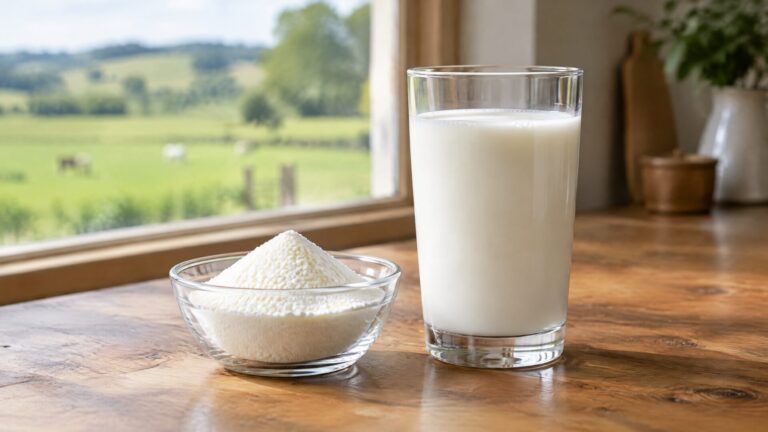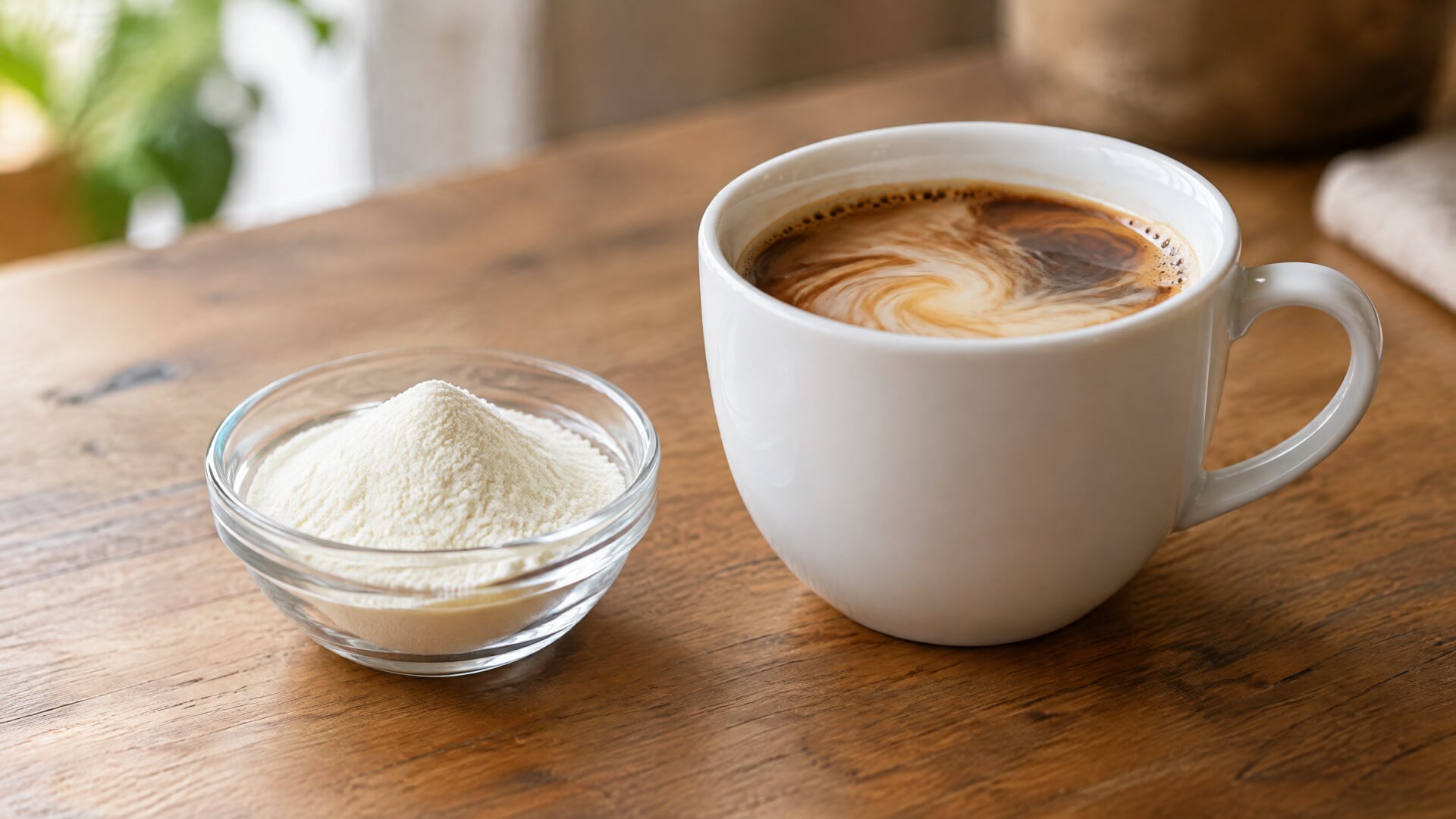

Non-dairy creamer is one of the most widely-used engineered food ingredients you’ve probably never thought about – it’s in your instant coffee, your 3-in-1 sachets, your instant soups and cereals. For food manufacturers it solves a very specific problem: adding creamy richness that’s shelf-stable, cheap, and dairy-free.
What Is Non-Dairy Creamer?
Non-dairy creamer (also called coffee creamer or whitener) is a manufactured ingredient that replaces milk or cream in food and beverage applications without using dairy. It’s typically a spray-dried powder built from three core components: a fat source (usually vegetable oil), a carbohydrate carrier (commonly glucose syrup solids or maltodextrin), and emulsifiers and stabilizers that let the fat disperse smoothly into hot liquid. The result is a free-flowing powder that dissolves into coffee, tea, or other products to deliver a creamy texture and appearance.
Key Benefits
Dairy-Free and Lactose-Free
Its primary appeal is providing creamy mouthfeel without milk, making it suitable for lactose-intolerant consumers and, depending on formulation, vegan products.
Long Shelf Life and Stability
As a low-moisture spray-dried powder, non-dairy creamer is shelf-stable without refrigeration and resists spoilage far better than dairy – a major advantage for instant products and long-distance distribution.
Consistent Texture and Whitening
Non-dairy creamer delivers reliable, uniform creaminess and a bright whitening effect batch after batch, which is why it’s a staple in instant coffee mixes, 3-in-1 sachets, and powdered beverage systems.
Formulation Flexibility and Cost
It’s cost-effective and highly adaptable – manufacturers can adjust fat content, whitening power, and dissolution properties to suit everything from coffee to soups, sauces, and bakery applications.
Common Forms Used in Formulation
- Standard non-dairy creamer – general-purpose whitener for coffee, tea, and instant beverages.
- High-fat creamer – richer mouthfeel for premium and specialty applications.
- Specialty grades – formulated for acid stability (for flavoured/fruit beverages), foaming (for cappuccino mixes), or clean-label requirements.
Sourcing and Quality Considerations for Manufacturers
The fat source is the key specification: creamers made with hydrogenated oils may contain trans fats and are increasingly avoided, so buyers should confirm the oil type (many now use palm, coconut, or high-oleic oils) and request a trans-fat-free specification. Fat content, solubility, whitening power, and acid/heat stability should all be defined for the intended application. A certificate of analysis should confirm moisture, fat, microbiological limits, and allergen status (some creamers contain milk-derived caseinate, which affects dairy-free/vegan and allergen labelling). Confirm origin and non-GMO documentation for clean-label products.
Safety and Side Effects
Non-dairy creamer is safe as a food ingredient. The main considerations are nutritional and labelling-related: traditional creamers can be high in saturated fat and, if made with hydrogenated oil, trans fat – both increasingly scrutinized. Note that “non-dairy” creamers may still contain milk-derived sodium caseinate, so they are not always suitable for milk-allergic consumers unless specifically formulated and labelled as such.
Frequently Asked Questions
What is non-dairy creamer made of?
Non-dairy creamer is typically made from vegetable oil, a carbohydrate carrier such as glucose syrup solids or maltodextrin, and emulsifiers and stabilizers, spray-dried into a free-flowing powder.
Is non-dairy creamer actually dairy-free?
Not always. Many non-dairy creamers contain milk-derived sodium caseinate, so they are not necessarily suitable for milk-allergic or strictly vegan consumers unless formulated and labelled accordingly.
Why do manufacturers use non-dairy creamer instead of milk?
It’s shelf-stable without refrigeration, cost-effective, delivers consistent creaminess and whitening, and is ideal for instant and powdered products – advantages dairy can’t match in these applications.
Does non-dairy creamer contain trans fats?
It can if made with hydrogenated oils, though many modern creamers use non-hydrogenated palm, coconut, or high-oleic oils. Buyers should request a trans-fat-free specification.
Sourcing non-dairy creamer for your formulation?
FC Materials supplies standard, high-fat, and specialty non-dairy creamer grades for food and beverage manufacturers. Tell us your product needs and our team will respond with specs, pricing, and MOQ.