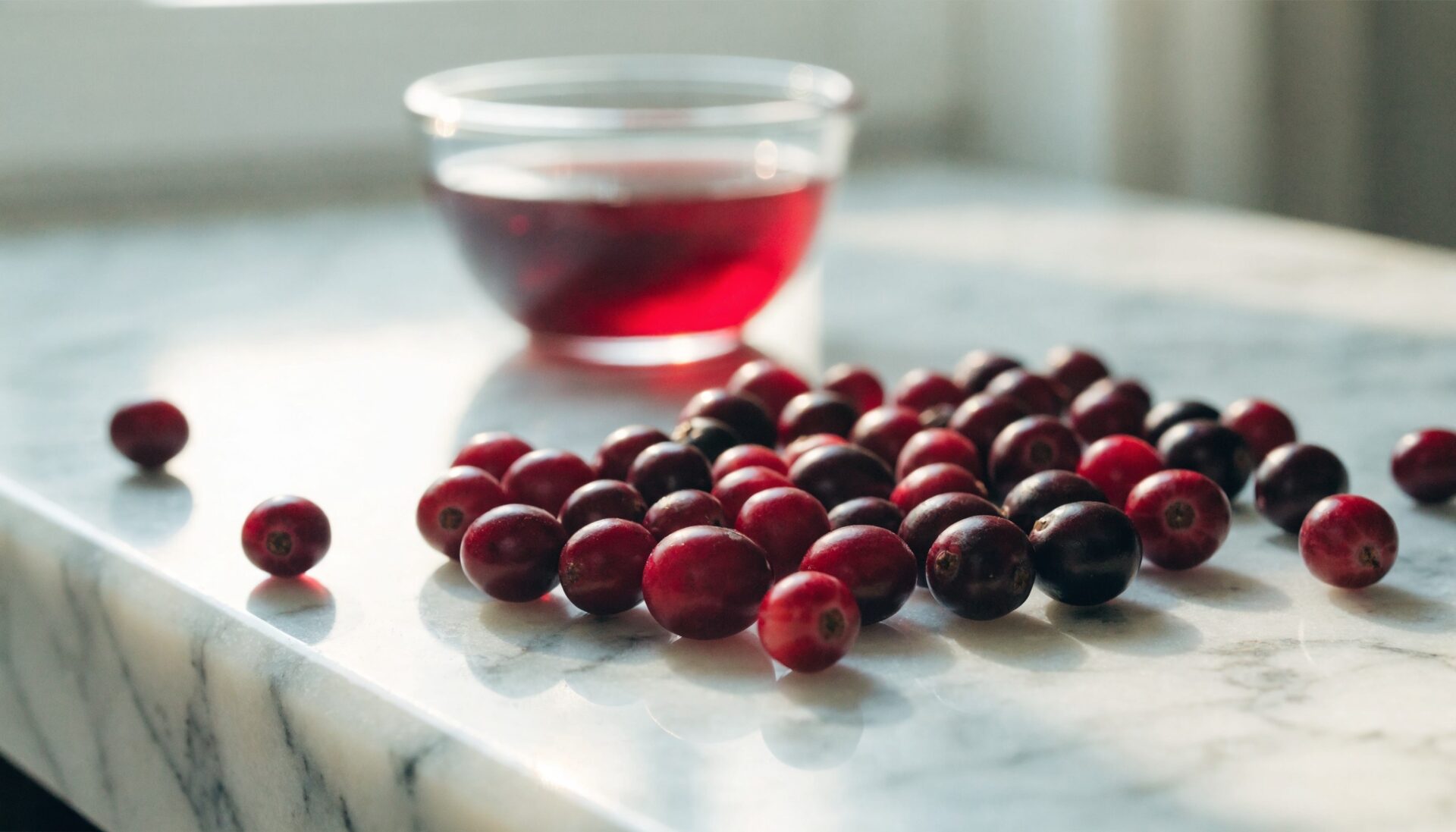

Few fruits carry as much folklore-turned-science as the cranberry. Native to North America and grown commercially across cooler climates, this small, tart red berry has moved from Thanksgiving side dish to daily wellness staple, showing up in juices, dried snacks, capsules, and increasingly in the ingredient lists of supplement and functional food brands. The reason isn’t just tradition: cranberries carry a distinctive profile of proanthocyanidins (PACs), organic acids, and polyphenols that researchers have linked to urinary tract, cardiovascular, and skin health.
What Is Cranberry?
Cranberry (Vaccinium macrocarpon) is a low-growing evergreen shrub native to bogs and wetlands, most commonly cultivated in North America. The fruit itself is small, firm, and intensely tart, which is why the vast majority of cranberries are consumed as juice, dried “craisins,” powder, or extract rather than eaten raw. For formulators, cranberry is available in several standardized forms, whole fruit powder, juice concentrate, and PAC-standardized extract, each suited to different applications from beverages to capsules.
Key Health Benefits of Cranberry
Urinary Tract Health
Cranberry’s best-known benefit is its long association with urinary tract health. Compounds called A-type proanthocyanidins are believed to help prevent certain bacteria (including E. coli) from adhering to the urinary tract lining, which is why cranberry extract remains one of the most searched and most formulated botanical ingredients in the women’s health category. The same anti-adhesion mechanism has also been studied for its potential to help stop H. pylori bacteria from clinging to the stomach wall, an emerging area of interest for digestive health formulations.
Heart and Antioxidant Support
Cranberries are rich in polyphenols, a class of antioxidant compounds linked to reduced oxidative stress and support for healthy cholesterol and blood vessel function. Their antioxidant density is among the highest of commonly consumed fruits, which has made cranberry extract a popular addition to general wellness and heart-health formulations.
Skin and Beauty-From-Within
The same polyphenols that support cardiovascular health also make cranberry a candidate ingredient in beauty-from-within formulations, where antioxidant protection against environmental and oxidative skin stress is a key selling point.
Digestive and Gut Health
Cranberry’s organic acid and polyphenol content has also been studied for its role in supporting a balanced gut microbiome, including promoting growth of beneficial bacteria such as Akkermansia muciniphila, complementing its more established urinary health reputation.
Cranberry Benefits for Men and Women
While cranberry is most closely associated with women’s health, particularly around urinary tract support, research and consumer interest increasingly extend to men’s health as well, including prostate and general urinary comfort. Cranberry-based formulations for men typically pair the extract with zinc or saw palmetto, while women’s formulations often combine it with D-mannose or probiotics for a broader urinary-support stack.
Common Forms Used in Formulation
- Juice concentrate, used in beverages and liquid supplements, valued for flavor as much as function.
- Whole fruit powder, a cost-effective option for capsules, gummies, and food applications where a full-spectrum ingredient is preferred.
- PAC-standardized extract, the preferred format for urinary-health-positioned supplements, since it allows brands to make a measurable potency claim.
Safety and Side Effects
Cranberry is generally well tolerated. In high doses, particularly from concentrated juice or extract, some people report mild digestive upset. Because cranberry can interact with certain blood-thinning medications, products intended for at-risk populations typically carry a standard precautionary note advising consultation with a healthcare provider. Cranberry is not known to cause the kind of serious adverse effects associated with some other botanical extracts, which is part of why it remains such a widely accepted ingredient across age groups.
Sourcing and Quality Considerations for Manufacturers
Cranberry extract quality is largely defined by its PAC (proanthocyanidin) content and the extraction method used to isolate it. Buyers formulating urinary-health products typically request PAC percentage by the DMAC method (the industry-standard assay), confirmation of North American sourcing, and testing to confirm the extract is free of the sugars and pesticide residues that can vary widely between suppliers.
Frequently Asked Questions
Is dried cranberry as beneficial as fresh?
Dried cranberries retain much of the fruit’s polyphenol content, though added sugar in many commercial dried products can offset some of the nutritional benefit. Unsweetened dried cranberry or standardized extract is generally preferred for formulation purposes.
How much cranberry extract is typically used in supplements?
Most urinary-health formulations use cranberry extract standardized to a specific PAC content, commonly in the 36mg PAC range per serving, based on published research, though exact dosing depends on the extract’s concentration and the product’s positioning.
Can cranberry be used in food and beverage products, not just supplements?
Yes. Cranberry’s tart flavor profile makes it a natural fit for juices, functional beverages, sauces, and baked goods, in addition to capsules and gummies.
Sourcing cranberry extract for your formulation?
FC Materials supplies cranberry extract and other antioxidant-rich botanical ingredients to supplement, nutraceutical, and food manufacturers. Tell us your product needs and our team will respond with specs, pricing, and MOQ.
What should I avoid when taking cranberry supplements?
Those on blood-thinning medication like warfarin, or with a history of kidney stones, should consult a healthcare provider before regular cranberry supplementation, since concentrated extracts are more acidic and potent than whole fruit.