
Skin & Joint Actives
Hyaluronic Acid & Sodium Hyaluronate Supplier in Malaysia
FC Materials supplies hyaluronic acid powder — sold in its stable salt form, sodium hyaluronate — to supplement and personal-care manufacturers. Tell us your application and the molecular weight you need, and our team will confirm availability and send the specification and COA.
Ingredient Profile
Hyaluronic Acid at a Glance
| Property | Detail |
|---|---|
| Names | Hyaluronic acid, hyaluronan; the sodium salt is sodium hyaluronate |
| CAS numbers | 9004-61-9 (hyaluronic acid); 9067-32-7 (sodium hyaluronate) |
| INCI name | Sodium Hyaluronate (the salt form most cosmetic grades are declared as) |
| Structure | Linear, non-sulfated glycosaminoglycan built from a repeating disaccharide of D-glucuronic acid and N-acetyl-D-glucosamine |
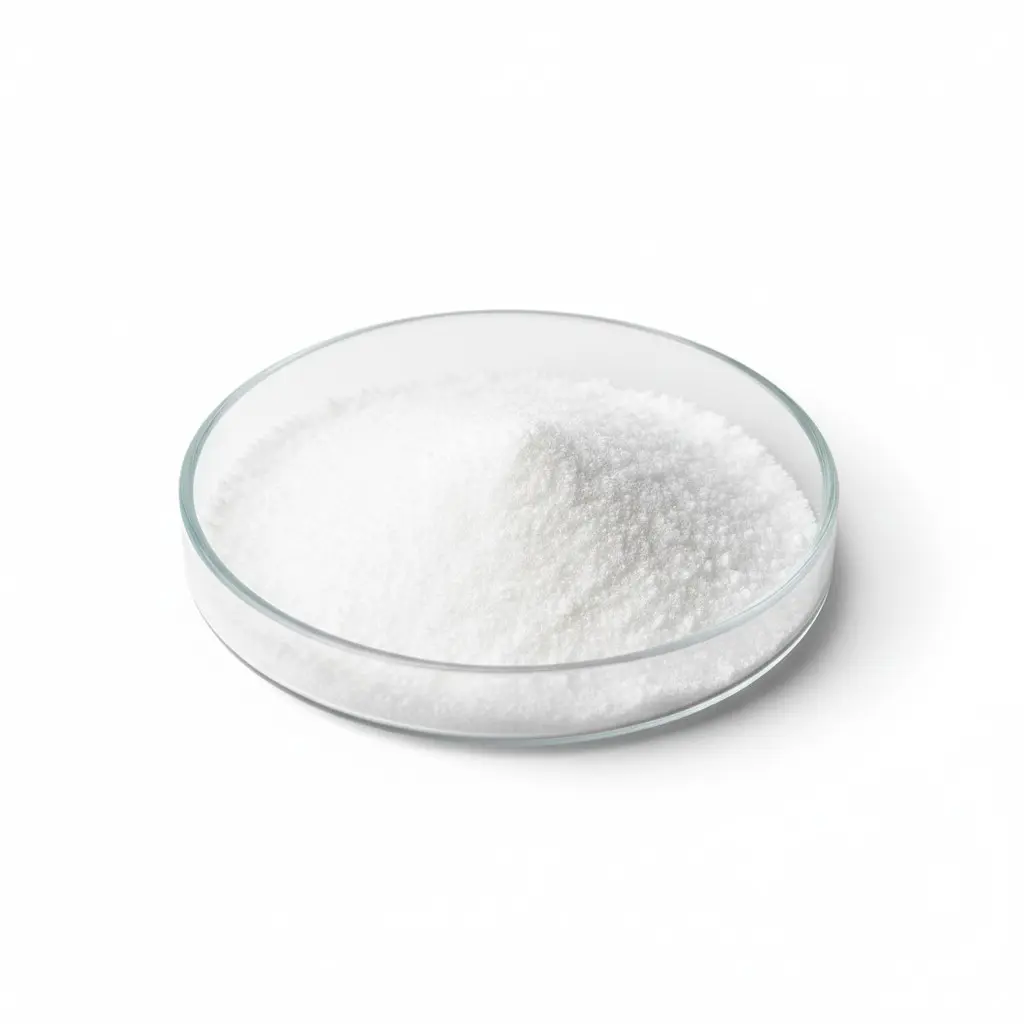
| Form | Usually a white or off-white, moisture-sensitive powder that dissolves in water to give a viscous solution |
| What sets the grade | Molecular weight (chain length) — it controls viscosity, feel and the role in a formula |
| Source | Mostly bacterial fermentation today; traditionally extracted from animal tissue such as rooster comb |
| What we supply | Hyaluronic Acid, >90% purity and sodium hyaluronate (the sodium salt) — specification and COA on request |
Know What You Are Buying
Hyaluronic Acid or Sodium Hyaluronate?
Most powder sold as “hyaluronic acid” is actually sodium hyaluronate. The free acid is harder to handle, so producers isolate the polymer as its sodium salt. It is the same hyaluronan chain; the sodium ion simply balances each carboxyl group.
For buyers, two points matter. First, your ingredient declaration should match the form on the specification. Second, check how the assay is expressed — as sodium hyaluronate, as hyaluronic acid or as glucuronic acid. The same material gives a different number on each basis, so compare offers on the same basis.
Read the full comparison: Sodium hyaluronate vs hyaluronic acid — what is the difference?
Grades
Choose the Grade by Molecular Weight
| Grade | Behaviour in a formula | Where it is used |
|---|---|---|
| High molecular weight (HMW) | Builds viscosity and leaves a film on the skin surface that holds water | Serums, gels, moisturisers and eye creams; also used in some oral supplement trials |
| Low molecular weight (LMW) | Thinner solutions; smaller chains. HA below about 100 kDa has been reported to penetrate skin [1] | Leave-on hydration products, often blended with an HMW grade |
| Hydrolysed / oligo HA | Very short chains with low viscosity, so solutions stay thin and pourable | Toners, mists and other low-viscosity liquids |
Suppliers draw the boundaries between “high” and “low” differently. Compare offers by the stated range in kDa (or intrinsic viscosity) and the test method, not by the label alone. Our molecular weight guide explains how to read these figures.
Applications
Where Our Customers Use Hyaluronic Acid
Beauty supplements
Capsules, sachets and beauty drinks built around skin hydration, often with collagen and vitamin C. See what the research on oral HA says.
Joint-health formulas
Combined with chondroitin sulfate, glucosamine or N-acetyl-D-glucosamine in mobility supplements.
Skin care & cosmetics
Humectant and texture agent in serums, creams and masks, often paired with glycerine. See what hyaluronic acid does.
Evidence
What the Research Says
- A 2025 meta-analysis of 7 randomised controlled trials found statistically significant improvements in skin hydration, elasticity and wrinkle depth with oral hyaluronic acid. Effects on firmness, wrinkle volume and water loss were not significant. The authors note the small total sample and differences between studies. [2]
- In a 12-week double-blind trial in 150 healthy Caucasian adults, oral sodium hyaluronate (1.8 MDa) at 120 mg a day improved skin hydration and elasticity and reduced water loss and wrinkle depth around the eyes versus placebo. 60 mg a day had similar but more modest effects. The trial was run by a sodium hyaluronate producer. [3]
- In a 4-week double-blind trial in 36 elderly people with dry skin, a lotion with low molecular weight HA raised skin hydration more than a high molecular weight HA lotion or the plain lotion. Water loss and symptom scores did not differ, and no side effects were found. [4]
- A 2016 review of randomised, placebo-controlled trials from 2008 to 2015 reported that oral HA reduced symptoms linked to synovitis, particularly knee pain. Most of the review’s authors work for an HA producer. [5]
These summaries describe published research on the ingredient. They are not claims for any finished product; claims on finished products must meet the rules of the market where they are sold.
References
- Zanchetta C, et al. Hyaluronic acid in topical applications: the various forms and biological effects of a hero molecule in the cosmetics industry. Biomolecules. 2025;15(12):1656. doi:10.3390/biom15121656
- Amin P, et al. Oral hyaluronic acid supplement: efficacy in skin hydration, elasticity, and wrinkle depth reduction. J Drugs Dermatol. 2025;24(9):910-919. doi:10.36849/jdd.8542
- Dolečková I, et al. Oral sodium hyaluronate improves skin hydration, barrier function and signs of aging: a randomized, double-blind, placebo-controlled trial in 150 healthy adults. Sci Rep. 2025;16(1):2941. doi:10.1038/s41598-025-32758-5
- Muhammad P, et al. Effectiveness of topical hyaluronic acid of different molecular weights in xerosis cutis treatment in elderly: a double-blind, randomized controlled trial. Arch Dermatol Res. 2024;316(6):329. doi:10.1007/s00403-024-03003-2
- Oe M, et al. Oral hyaluronan relieves knee pain: a review. Nutr J. 2016;15:11. doi:10.1186/s12937-016-0128-2
Buying Checklist
What to Ask for on the Certificate of Analysis
- Assay, with the method and the basis (as sodium hyaluronate, hyaluronic acid or glucuronic acid).
- Molecular weight or intrinsic viscosity, with the method used.
- Protein content — a key purity check for fermentation grades.
- pH of a solution and loss on drying.
- Heavy metals and the microbiological profile (total plate count, yeasts and moulds, named pathogens).
- Source and certificates: production route, Halal certificate where needed, and the intended-use grade (cosmetic or oral).
Ask for a lot-specific COA, not a generic specification sheet, and keep it with your batch records.
Source & Compliance
Fermentation, Animal Source and Halal Status
Hyaluronic acid was traditionally extracted from animal tissue. Today it is produced mainly by microbial fermentation, using strains such as Streptococcus zooepidemicus and, more recently, engineered Bacillus subtilis and Corynebacterium glutamicum. Fermentation conditions also influence molecular weight. [6]
The source matters for Halal and vegan products. Fermentation-derived material avoids animal tissue, but Halal status still depends on the producer’s certification. Ask for the certificate and check it covers the grade you buy. Halal certification is available for applicable FC Materials ingredients; our team will confirm it for your grade.
Supplement products in Malaysia need NPRA registration. Our FC | Comply team supports registration documentation.
References
- Marwan-Abdelbaset E, et al. Microbial production of hyaluronic acid: the current advances, engineering strategies and trends. J Biotechnol. 2025;403:52-72. doi:10.1016/j.jbiotec.2025.03.015
Learn More
Hyaluronic Acid Guides for Formulators
Frequently Asked Questions
Hyaluronic Acid Questions from Buyers
Is sodium hyaluronate the same as hyaluronic acid?
Sodium hyaluronate is the sodium salt of hyaluronic acid. It is the same polymer chain, isolated as a salt because it is more stable and easier to handle. Most powder sold as hyaluronic acid is sodium hyaluronate.
What is sodium hyaluronate used for?
In cosmetics it is a humectant and texture agent in serums, creams and masks. In supplements it is taken by mouth in skin and joint formulas; placebo-controlled trials have reported improved skin hydration with 120 mg a day taken by mouth.
Does sodium hyaluronate have side effects?
In the topical trial we cite, no side effects were found over 4 weeks, and a 2025 review notes that the safety of HA-containing formulations has been evaluated in several clinical trials. Each finished product still needs its own safety assessment.
Can hyaluronic acid be used every day?
In the trials we cite, participants used it daily: a lotion for 4 weeks, and oral doses for 12 weeks.
Is hyaluronic acid powder safe to drink?
Oral sodium hyaluronate has been studied at 60 to 120 mg a day for 12 weeks in placebo-controlled trials. A finished supplement must meet NPRA requirements in Malaysia. The trials we cite report skin outcomes rather than detailed safety data, so ask the producer for safety data on the oral grade you buy.
Which molecular weight should I choose?
It depends on the product. High molecular weight grades build viscosity and a surface film; low molecular weight and hydrolysed grades give thinner solutions. Compare grades by the kDa range and the test method.
Is your hyaluronic acid Halal?
Halal certification is available for applicable ingredients. Our team will confirm the certification status for the grade you need.
What is your minimum order quantity, and can I get a sample?
MOQ varies by grade. Samples are available for most ingredients to support formulation trials. Send us your application and volume for a tailored quote.
Sourcing Hyaluronic Acid or Sodium Hyaluronate?
Tell us your application, target molecular weight and volume. We will confirm availability and send the specification, COA and pricing.