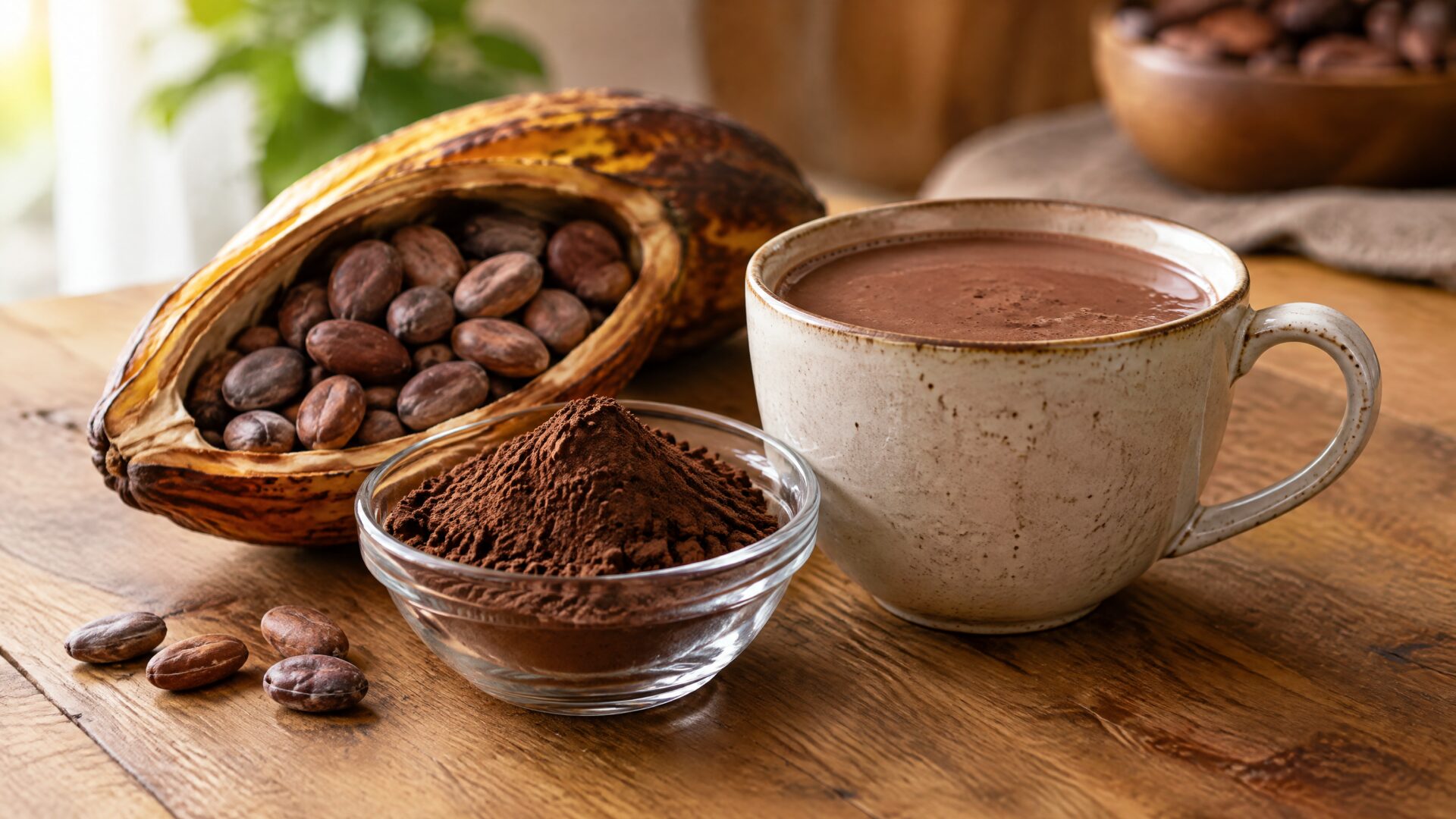

Cocoa powder, known in Malay as serbuk koko, is what remains when roasted cocoa beans are ground and most of the cocoa butter is pressed out. It gives chocolate flavour and colour to drinks, cakes, biscuits, ice cream and nutrition powders. This guide explains the types of cocoa powder, how they behave in recipes, what human studies report on cocoa flavanols, and what buyers should check.
How Cocoa Powder Is Made
Cocoa beans are the seeds of the cacao tree, Theobroma cacao. After fermentation and drying, the beans are roasted, shelled and ground into a paste called cocoa liquor or cocoa mass. Pressing this paste separates cocoa butter from a solid cake. The cake is then milled into cocoa powder.
How hard the paste is pressed decides how much fat stays in the powder. Cocoa powder is commonly traded as low-fat grades of around 10–12% and high-fat grades of around 22–24%. Higher fat gives a richer taste and mouthfeel; lower fat suits dry mixes where the formula supplies its own fat.
Natural or Dutch-Processed Cocoa?
This is the first choice to make, because the two families are not interchangeable.
- Natural cocoa powder keeps the bean’s acidity. In one survey of commercial powders, natural cocoas had an extractable pH of 5.3–5.8 [4]. It is light brown with a sharper, fruity flavour. Because it is acidic, it reacts with baking soda to help cakes rise.
- Dutch-processed (alkalised) cocoa powder is treated with an alkali to raise its pH. The same survey grouped alkalised powders as light (pH 6.50–7.20), medium (7.21–7.60) and heavy (7.61 and above) [4]. Colour deepens from red-brown to near black, and the flavour becomes milder. It does not react with baking soda, so recipes need baking powder instead.
Alkalisation also lowers cocoa flavanols, the compounds studied for health effects. Average total flavanols fell from 34.6 mg/g in natural cocoa to 13.8, 7.8 and 3.9 mg/g in lightly, medium and heavily alkalised cocoa [4]. The authors worked for a chocolate company. Still, the trade-off is plain: a darker, smoother powder carries fewer flavanols.
Cocoa or cacao powder?
Both words come from the same plant. “Cacao powder” is often used in retail for natural or less-processed powders, but the name alone does not tell you how a powder was made. The pH and fat content on the specification do.
Where Cocoa Powder Is Used
- Beverages: instant chocolate drinks, malted drinks, chocolate milk and vending mixes. Cocoa is hydrophobic and lumps easily, so it is usually dry-blended with sugar or dispersed under shear. In ready-to-drink milks it settles unless a stabiliser is used.
- Bakery and confectionery: cakes, brownies, biscuits, fillings and coatings. Match the cocoa type to the leavening.
- Dairy and frozen desserts: ice cream, yoghurt and puddings, where higher-fat powders give a fuller taste.
- Nutrition powders: protein shakes and meal replacements, where cocoa helps mask other flavours.
Chocolate drinks often combine cocoa with malt extract and a non-dairy creamer. Where cocoa alone gives too little chocolate character, a flavour such as FCM-18110 Chocolate can lift it.
What the Research Says
Studies test cocoa flavanols, delivered as cocoa extract, high-flavanol cocoa or dark chocolate. Ordinary alkalised cocoa powder in a sweetened drink is a different product.
- Blood pressure. A 2017 Cochrane review of 35 trials (1,804 mainly healthy adults) found that flavanol-rich cocoa lowered blood pressure by about 2 mmHg over 2–18 weeks. Systolic pressure fell by 4 mmHg in people with hypertension, with no significant change in people with normal blood pressure. The evidence was rated moderate, with signs of reporting bias in industry-linked trials [1].
- Cholesterol and blood sugar. A 2024 meta-analysis of 31 trials (1,986 adults) found that cocoa extract or dark chocolate lowered LDL cholesterol by 9.47 mg/dL and fasting glucose by 4.91 mg/dL. Body weight, triglycerides, HDL cholesterol and HbA1c did not change [2].
- Heart events. The COSMOS trial gave 21,442 older adults a cocoa extract with 500 mg of flavanols a day, or placebo, for a median of 3.6 years. Total cardiovascular events were not significantly reduced. Cardiovascular deaths were 27% lower, a secondary finding that needs confirmation [3].
These summaries describe published research on the ingredient. They are not claims for any finished product; claims on finished products must meet the rules of the market where they are sold.
What to Check Before You Buy
- pH. It tells you at once whether a powder is natural or alkalised, whatever the name on the bag says.
- Fat content. Stated as a range, with the test method.
- Colour and fineness. Colour grade, and the share passing a fine sieve. Coarse particles cause specks and grittiness.
- Moisture, ash and shell content. High shell content lowers quality.
- Cadmium and lead. The cacao plant takes up cadmium from soil, and levels vary with origin [5][6]. Ask for results together with the country of origin.
- Microbiology. Total plate count, yeast and mould, E. coli and Salmonella.
- Halal and regulatory documents. A current Halal certificate reference. Our FC | Comply team can advise on Malaysian labelling and registration questions.
Safety and Regulation
Cocoa powder is a widely eaten food. The main regulatory issue for buyers is cadmium. In the EU, cocoa powder sold to consumers, or used in drinking chocolate, may contain no more than 0.60 mg/kg of cadmium [7]. A Japanese survey found cadmium from 0.015 to 1.8 mg/kg in retail cocoa powders, with 26 of 140 products above the EU limits [5]. A US FDA study found higher cadmium in products from Latin America than from Africa [6].
If you export finished products, check the cadmium limits of each target market at the specification stage. The trials above also reported few side effects: gastrointestinal complaints and nausea in about 1% of people taking cocoa products [1].
Frequently Asked Questions
What is the difference between cocoa powder and chocolate powder?
Cocoa powder is unsweetened ground cocoa solids. “Chocolate powder” or drinking chocolate usually means cocoa powder blended with sugar and sometimes milk or creamer.
Can I swap natural and Dutch-processed cocoa?
Not without changing the recipe. Natural cocoa is acidic and reacts with baking soda; Dutch-processed cocoa does not, so it needs baking powder. Colour and flavour also change.
Is cocoa powder healthy?
Trials of flavanol-rich cocoa found small falls in blood pressure and LDL cholesterol [1][2]. Alkalisation and added sugar reduce that relevance, because alkalised cocoa carries far fewer flavanols [4].
Why does cadmium matter in cocoa powder?
Cacao takes up cadmium from soil, and some origins are higher than others [5][6]. The EU limit for consumer cocoa powder is 0.60 mg/kg [7].
What cocoa powder does FC Materials supply?
We supply a Halal-certified, food-grade cocoa powder for beverages, bakery, confectionery and dairy. Ask us for the specification and certificate of analysis.
References
- Ried K, Fakler P, Stocks NP. Effect of cocoa on blood pressure. Cochrane Database Syst Rev. 2017;4(4):CD008893. doi:10.1002/14651858.CD008893.pub3
- Arisi TOP, da Silva DS, Stein E, et al. Effects of cocoa consumption on cardiometabolic risk markers: meta-analysis of randomized controlled trials. Nutrients. 2024;16(12):1919. doi:10.3390/nu16121919
- Sesso HD, Manson JE, Aragaki AK, et al. Effect of cocoa flavanol supplementation for the prevention of cardiovascular disease events: the COcoa Supplement and Multivitamin Outcomes Study (COSMOS) randomized clinical trial. Am J Clin Nutr. 2022;115(6):1490-1500. doi:10.1093/ajcn/nqac055
- Miller KB, Hurst WJ, Payne MJ, et al. Impact of alkalization on the antioxidant and flavanol content of commercial cocoa powders. J Agric Food Chem. 2008;56(18):8527-33. doi:10.1021/jf801670p
- Kataoka Y, Watanabe T, Hayashi K, Akiyama H. Surveillance of cadmium concentration in chocolate and cocoa powder products distributed in Japan. Shokuhin Eiseigaku Zasshi. 2018;59(6):269-274. doi:10.3358/shokueishi.59.269
- Abt E, Fong Sam J, Gray P, Robin LP. Cadmium and lead in cocoa powder and chocolate products in the US market. Food Addit Contam Part B Surveill. 2018;11(2):92-102. doi:10.1080/19393210.2017.1420700
- Commission Regulation (EU) 2023/915 of 25 April 2023 on maximum levels for certain contaminants in food (consolidated text), entry 3.2.15.4. EUR-Lex.
Source it from FC Materials: Cocoa powder and Malt extract – specification, COA and Halal documents on request.
Sourcing cocoa powder for your product?
FC Materials supplies Halal-certified cocoa powder and malt extract, plus chocolate flavour compounds, to food, beverage and nutrition manufacturers. Tell us your application and volume and our team will respond with specs, pricing and MOQ.