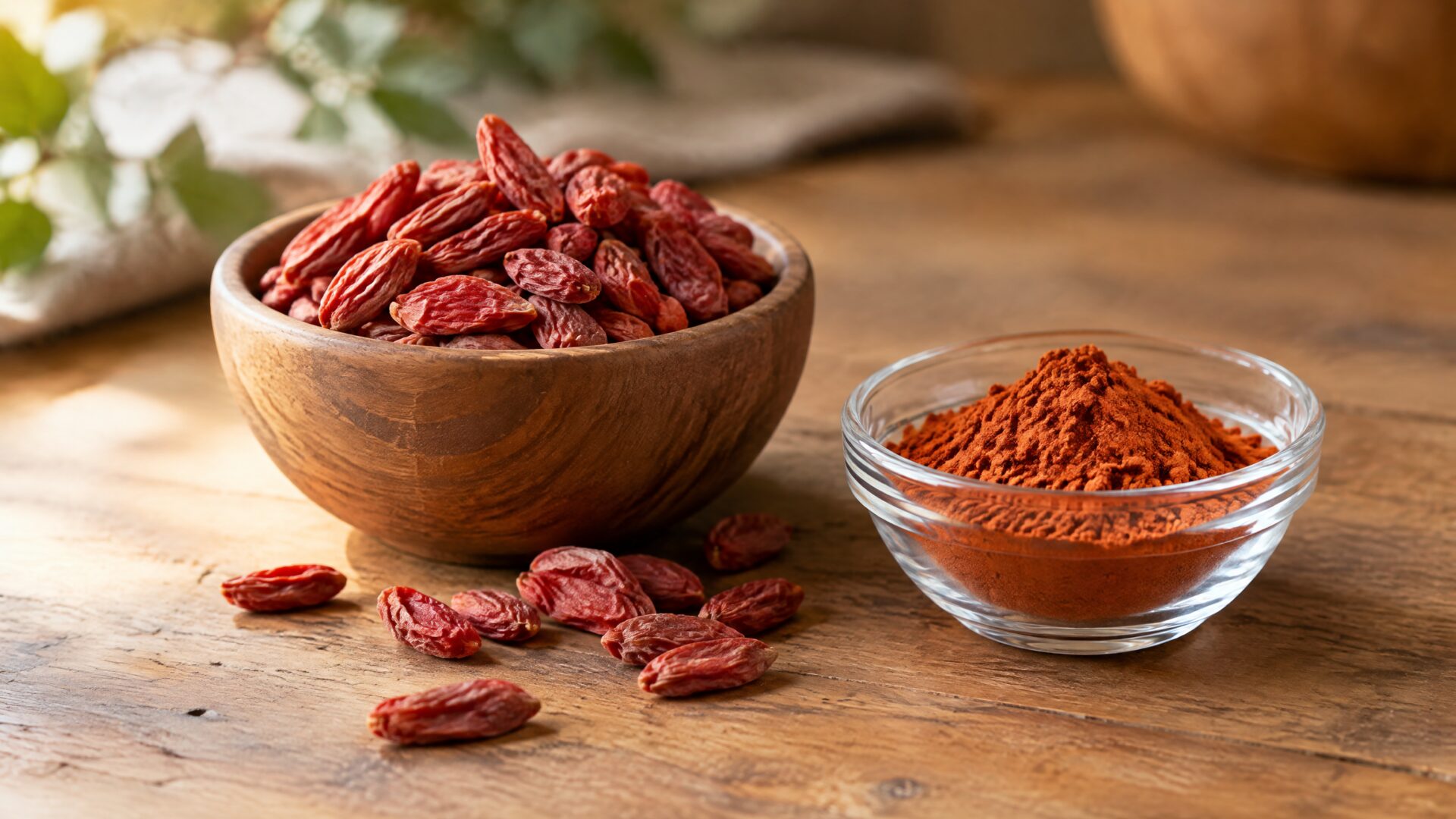

Goji berry is the small red-orange fruit of Lycium barbarum, also called wolfberry. In Malaysia it is known as buah goji. Chinese cooks call it gou qi zi (often written kei chi) and add the dried berries to soups and herbal teas. This guide explains what goji contains, what human studies report, and what manufacturers should check before they buy goji ingredients.
What Is Goji Berry?
Goji comes from a shrub in the Solanaceae family, the same family as tomato and chilli. Commercial goji is mainly Lycium barbarum; the related Lycium chinense is also traded. The fresh fruit is delicate, so nearly all goji in trade is dried, powdered, juiced or extracted.
Two groups of compounds get most of the attention:
- Lycium barbarum polysaccharides (LBP): water-soluble carbohydrates that are the usual marker for goji extracts.
- Zeaxanthin: a yellow carotenoid, present mainly as zeaxanthin dipalmitate. It is one of the pigments in the macula of the eye. It is fat-soluble, so a hot-water polysaccharide extract carries little of it.
This split matters. A product aimed at eye health and a product aimed at a polysaccharide claim may need different goji fractions.
Forms of Goji Used by Manufacturers
- Dried whole berries: for snacks, trail mixes, teas and traditional soups.
- Goji powder or juice powder: the whole fruit, dried and milled, for smoothies and drink mixes. It keeps more of the carotenoids, along with the fruit sugars.
- Standardised goji extract: concentrated to a stated polysaccharide content for capsules, tablets and functional drinks. FC Materials supplies a Goji Berry Extract with more than 50% polysaccharides (titrated).
What the Research Says
Human evidence on goji is limited. There are few randomised trials, and most are small. The clearest findings concern blood lipids and macular pigment.
- Blood lipids. A 2023 meta-analysis of 5 randomised controlled trials (259 adults) found that goji lowered triglycerides and raised HDL cholesterol. Total and LDL cholesterol did not change significantly. The authors say larger studies are needed [1].
- Macular pigment in healthy adults. In a randomised pilot study, 27 adults aged 45–65 ate 28 g of goji berries five times a week for 90 days. Macular pigment optical density and skin carotenoids rose in the goji group, but not in a group taking a lutein and zeaxanthin supplement. The study was small and not blinded [2].
- Macular pigment in early AMD. In 114 people with early age-related macular degeneration, 25 g of goji a day for 90 days raised serum zeaxanthin and macular pigment compared with a normal diet. The control group received no placebo [3].
Immune effects are often claimed for goji polysaccharides, but we found no meta-analysis of human trials on immune outcomes. Brands should treat immune positioning with care.
These summaries describe published research on the ingredient. They are not claims for any finished product; claims on finished products must meet the rules of the market where they are sold.
What to Check Before You Buy
Goji quality varies with species, origin and processing. Build these checks into your specification:
- Species and origin. Lycium barbarum or L. chinense, plant part (fruit) and growing region, for example Ningxia, on the documents.
- Polysaccharide content and method. Colorimetric methods can also react with free sugars, and dried goji is rich in sugar. Ask for the method and, where possible, the free-sugar result.
- Zeaxanthin. If the product is aimed at eye health, ask for zeaxanthin content, because water extracts carry little.
- Pesticide residues and sulphites. Ask for a full pesticide screen and a sulphur dioxide (SO2) result for dried fruit.
- Heavy metals, residual solvents and microbiology. Lead, arsenic, cadmium, mercury, total plate count, yeast and mould, E. coli and Salmonella.
- Halal and regulatory documents. For supplements sold in Malaysia, our FC | Comply team can advise on the NPRA documents you need.
Goji is often combined with other eye and antioxidant ingredients, such as chrysanthemum extract or astaxanthin, and with traditional tonic herbs such as schizandra.
Safety
Goji is a long-established food in Chinese cooking, but two safety points deserve attention on labels and in product files.
- Warfarin. A 2021 systematic review of foods and herbs that interact with warfarin listed Chinese wolfberry among those linked to a higher risk of bleeding [4]. People taking warfarin or other anticoagulants should speak to their doctor before regular use.
- Allergy. In a Spanish study of 31 people with plant-food allergies, 24 (77%) had positive skin tests to goji. Sensitisation was linked to lipid transfer proteins shared with foods such as peach and tomato [5].
Frequently Asked Questions
Is goji berry the same as wolfberry and kei chi?
Yes. Goji, wolfberry, buah goji and gou qi zi (kei chi) all refer to the fruit of Lycium barbarum, and sometimes the related L. chinense.
What are goji berries good for?
Small trials found that eating goji raised macular pigment over 90 days [2][3]. A meta-analysis of 5 trials found lower triglycerides and higher HDL cholesterol [1]. The evidence base is small, and larger trials are needed.
Which goji ingredient should I use?
Use dried berries or whole-fruit powder for food and drinks. Use a standardised extract where a consistent polysaccharide dose is needed. For eye-health products, check the zeaxanthin content, because water extracts carry little.
Can goji interact with medicines?
Chinese wolfberry is listed among foods linked to a higher bleeding risk with warfarin [4]. Anyone on anticoagulants should ask their doctor first.
What goji ingredient does FC Materials supply?
We supply Goji Berry Extract standardised to more than 50% polysaccharides (titrated). It is Halal-certified. Ask us for the specification and certificate of analysis.
References
- Zeng X, Zhao W, Wang S, et al. L. barbarum (Lycium barbarum L.) supplementation for lipid profiles in adults: a systematic review and meta-analysis of RCTs. Medicine (Baltimore). 2023;102(39):e34952. doi:10.1097/MD.0000000000034952
- Li X, Holt RR, Keen CL, et al. Goji berry intake increases macular pigment optical density in healthy adults: a randomized pilot trial. Nutrients. 2021;13(12):4409. doi:10.3390/nu13124409
- Li S, Liu N, Lin L, et al. Macular pigment and serum zeaxanthin levels with Goji berry supplement in early age-related macular degeneration. Int J Ophthalmol. 2018;11(6):970-975. doi:10.18240/ijo.2018.06.12
- Tan CSS, Lee SWH. Warfarin and food, herbal or dietary supplement interactions: a systematic review. Br J Clin Pharmacol. 2021;87(2):352-374. doi:10.1111/bcp.14404
- Larramendi CH, García-Abujeta JL, Vicario S, et al. Goji berries (Lycium barbarum): risk of allergic reactions in individuals with food allergy. J Investig Allergol Clin Immunol. 2012;22(5):345-50. PubMed 23101309
Source it from FC Materials: Goji berry extract, Chrysanthemum extract and Astaxanthin – specification, COA and Halal documents on request.
Sourcing goji berry extract for your formulation?
FC Materials supplies standardised goji berry extract and related botanical extracts to supplement, food and beverage manufacturers. Tell us your product needs and our team will respond with specs, pricing and MOQ.