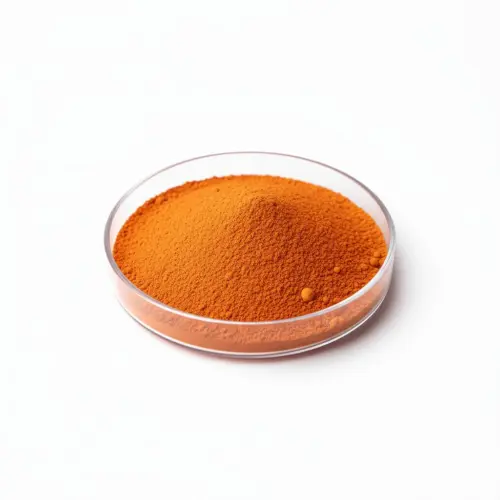
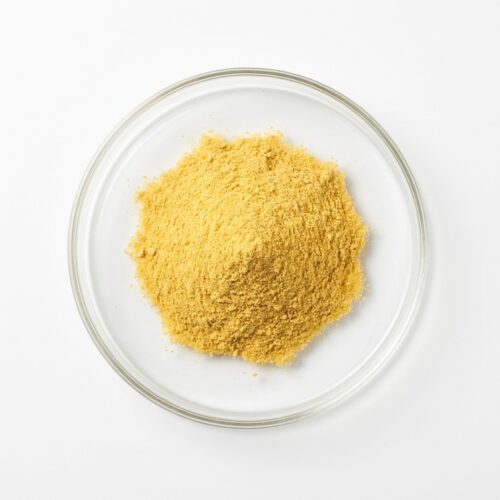
Isomalt DC 101 is an agglomerated grade of isomalt designed for direct compression: you can blend it with actives, flavour and lubricant and press tablets without a granulation step. FC Materials supplies it for sugar-free chewable tablets, lozenges, effervescent and nutraceutical tablets. It is produced in Germany under FSSC 22000, meets the isomalt specifications of Codex Alimentarius, the Food Chemicals Codex and Regulation (EU) No 231/2012, and Halal and Kosher certificates are available on request.
What is isomalt?
Isomalt is a sugar replacer (polyol, or sugar alcohol) made from sucrose. It is a mixture of two hydrogenated disaccharides: 6-O-α-D-glucopyranosyl-D-sorbitol (1,6-GPS) and 1-O-α-D-glucopyranosyl-D-mannitol (1,1-GPM). It is roughly half as sweet as sugar, with a clean, sugar-like taste, and it is only partly digested, which is why it is labelled at 2.4 kcal/g in the EU instead of 4 kcal/g for sugar. Isomalt is not a sugar on the nutrition label: it is declared as a polyol.
Isomalt vs sugar
As a sugar substitute, isomalt behaves much like sugar in bulk and texture but differs in three ways that matter to manufacturers. It is about half as sweet, so it is often combined with a high-intensity sweetener. It is only partly digested, so it raises blood sugar much less than sucrose and is widely used in sugar-free and reduced-sugar confectionery. Diabetic or blood-sugar wording on labels is regulated, so check your market’s rules. And it is stable at high temperatures, resisting browning and crystallisation (crystallization), which is why it is used for clear hard candy and sugar work. The powder is odourless, white and free-flowing.
In tablets and candy, isomalt is often paired with a high-intensity or artificial sweetener such as sucralose, acesulfame K or steviol glycosides to bring sweetness closer to table sugar, while isomalt provides the bulk. Compared to sugar it has about 60% of the caloric value for labelling in the EU (2.4 vs 4 kcal per gram) and a much lower glycaemic (glycemic) response.
Isomalt DC 101 specification
| Parameter | Specification | Method |
|---|---|---|
| GPM + GPS | min. 98 g/100 g dry matter | DIN EN 15086 |
| of which GPS | 43–57% | DIN EN 15086 |
| Water | max. 6.0 g/100 g | Karl Fischer |
| D-mannitol / D-sorbitol | max. 0.5 / 0.5 g/100 g dry matter | DIN EN 15086 |
| Reducing sugars (as glucose) | max. 0.2 g/100 g dry matter | ICUMSA, adapted |
| Conductivity | max. 20 µS/cm | ICUMSA, adapted |
| Sulphated ash | max. 0.05 g/100 g | — |
| Arsenic / lead / nickel | max. 0.2 / 0.2 / 1 mg/kg dry matter | ICUMSA / Ph. Eur. |
| Total heavy metals (as lead) | max. 10 mg/kg dry matter | FCC |
| Particle size | 0.1–0.8 mm for at least 90% by weight | ICUMSA sieve analysis |
| Bulk density | 0.38–0.48 g/cm³ | — |
| Colour in solution | max. 30 ICUMSA units | — |
| Total aerobic count | max. 100 cfu/g | ICUMSA |
| Yeasts / moulds | max. 10 / 10 cfu/g | ICUMSA |
| Coliforms (incl. E. coli) | negative in 25 g | DIN 10183, adapted |
| Identification | TLC and HPLC | — |
| Nutrient | Value | Note |
|---|---|---|
| Polyols (isomalt) | 94 g | |
| Sugars, fat, protein, fibre, salt | negligible | |
| Energy (EU) | 940 kJ / 226 kcal | polyols counted at 2.4 kcal/g |
| Calories (US) | 188 kcal | isomalt counted at 2.0 kcal/g |
Why an agglomerated grade for direct compression
Fine crystalline isomalt flows and compresses poorly on its own. In DC 101 the particles are agglomerated into porous granules of 0.1–0.8 mm with a low bulk density (0.38–0.48 g/cm³). This gives free flow into the die and good bonding under pressure, so a simple blend of isomalt, active ingredients, flavour and a lubricant such as magnesium stearate can be compressed directly. Typical uses are chewable vitamin and mineral tablets, sugar-free lozenges and mints, effervescent tablets and nutraceutical tablets.
Formulation notes: isomalt has low hygroscopicity, which helps tablets stay hard and non-sticky in humid climates. Lubricant level and blending time affect hardness, so optimise them on your press. For high-dose actives, check that the blend still flows and bonds; isomalt is often combined with other DC fillers.
Isomalt in confectionery and sugar art
Isomalt is widely used for sugar-free hard candy, and in cake decoration and sugar art, because it resists crystallising and browning when cooked and gives clear, glass-like pieces. Those uses usually call for a standard (non-agglomerated) isomalt grade rather than DC 101. Tell us your process and we will confirm the right grade.
Other uses of isomalt
- Sugar-free chewing gum coatings and centres
- Chocolate and compound coatings
- Baked goods and fillings, where it adds bulk without browning (recipes usually need reformulating)
- Coating and panning of tablets and confectionery
Labelling and regulatory notes
- Declare isomalt as a polyol, not a sugar. EU energy factor 2.4 kcal/g; US 2.0 kcal/g.
- In the EU, foods with more than 10% added polyols must carry the statement “excessive consumption may produce laxative effects”. Check the equivalent rule in your market.
- The EU has authorised claims for foods in which sugar replacers such as isomalt replace sugar, about the maintenance of tooth mineralisation and a lower blood-glucose rise after eating. Conditions of use apply, so check them before you use any claim.
- Isomalt contains sorbitol and mannitol units, so it is not suitable for people with hereditary fructose intolerance.
Storage and shelf life
- Store at 20 ± 5 °C and 20–60% relative humidity, in the original sealed packaging
- Minimum durability: 3 years from production under these conditions
- Not produced from ingredients or processing aids that need allergen labelling under EU rules; not derived from GMOs under German law; suitable for vegetarians and vegans
What the research says
- In a randomised, double-blind crossover trial, 19 healthy adults ate 30 g of isomalt or 30 g of sucrose a day for 4 weeks as part of a controlled diet. Isomalt was well tolerated: blood lipids and mineral balance were not affected, and stool frequency rose moderately without changes in stool consistency. [1]
- In the same trial design, faecal samples showed a shift towards more bifidobacteria with isomalt than with sucrose, while most other gut markers did not change. The authors describe isomalt as a fermentable, prebiotic-like carbohydrate. Both studies are small (19 volunteers). [2]
These summaries describe published research on the ingredient. They are not claims for any finished product; claims on finished products must meet the rules of the market where they are sold.
References
- Gostner A, et al. Effects of isomalt consumption on gastrointestinal and metabolic parameters in healthy volunteers. Br J Nutr. 2005;94(4):575-581. doi:10.1079/bjn20051510
- Gostner A, et al. Effect of isomalt consumption on faecal microflora and colonic metabolism in healthy volunteers. Br J Nutr. 2006;95(1):40-50. doi:10.1079/bjn20051589
What is on our certificate of analysis
Each batch is released against the specification for water, GPM + GPS and GPS share, mannitol, sorbitol, reducing sugars, conductivity, arsenic, nickel, lead, total heavy metals and particle size. Ask for the batch certificate with your quote.
Frequently asked questions
Is isomalt DC 101 Halal?
Yes. A Halal certificate is available on request, as is a Kosher certificate. It is also suitable for vegetarians and vegans.
What is the difference between isomalt and isomalt DC 101?
They are the same substance. DC 101 is agglomerated into porous granules (0.1–0.8 mm) so that it flows and compresses well for direct compression tableting. Standard isomalt grades are used for hard candy and sugar art.
Is isomalt sugar?
No. Isomalt is a polyol made from sugar. It is roughly half as sweet, partly digested, and labelled at 2.4 kcal/g in the EU. Read more in our isomalt guide.
Where is it made?
In Germany, under FSSC 22000, in line with Codex, FCC and Regulation (EU) No 231/2012. FC Materials supplies it from Penang, Malaysia.
What is the shelf life?
Three years from production in the sealed original packaging, stored at 20 ± 5 °C and 20–60% relative humidity.
Can I get a sample?
Yes. Tell us about your tablet or confectionery and your volume on WhatsApp or through the quote form.
Request a quote or sample. Send us your application, target specification and monthly volume and we will reply with availability, documents (specification, COA, SDS, Halal certificate) and pricing for isomalt DC 101. Request a quote or WhatsApp us.
Halal certification
This ingredient is listed as “Isomalt” on FC Materials’ Halal certificate (Sijil Pengesahan Halal, MS 1500:2019), issued through the Penang Islamic Religious Council (MAINPP) and the Department of Islamic Development Malaysia (JAKIM). Reference JAKIM.700-2/3/1 105-07/2022, valid until 15 October 2028. Ask us for a copy.