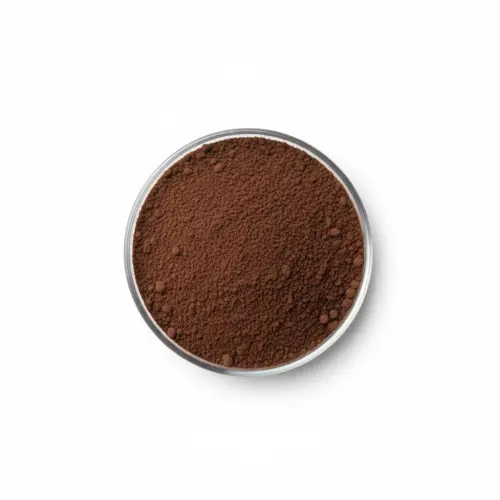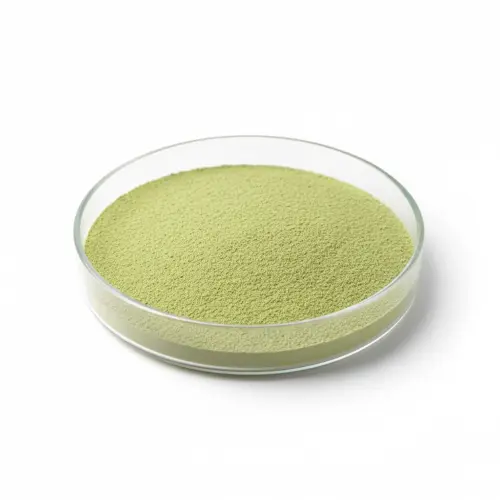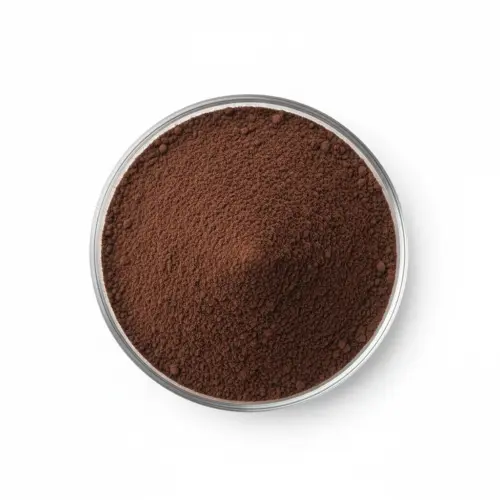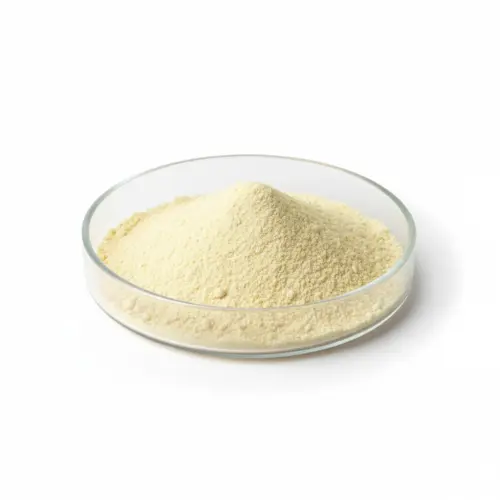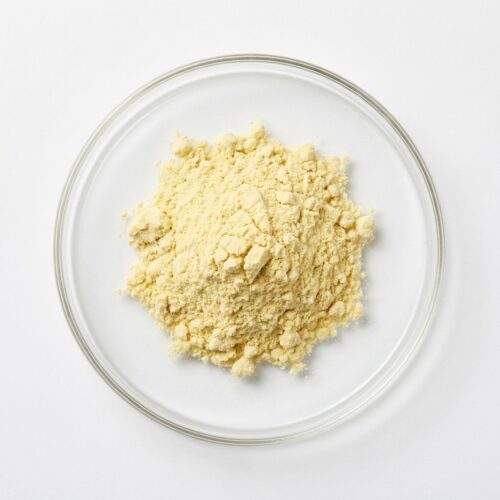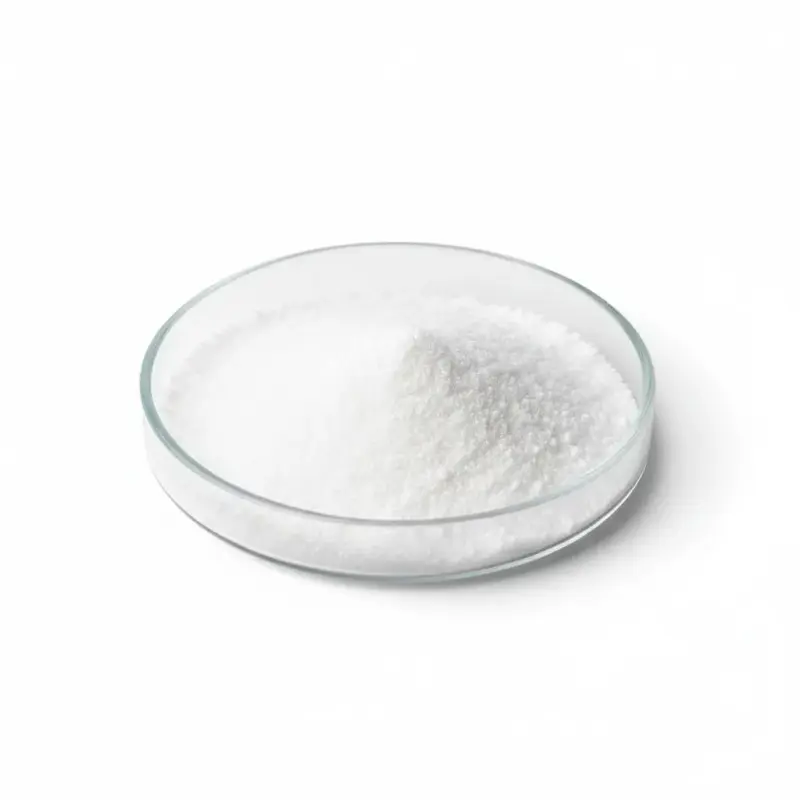
Resistant dextrin, also called resistant maltodextrin or soluble corn fibre, is a soluble dietary fibre made from starch. It dissolves easily, adds almost no taste, colour or viscosity, and is stable to heat and acid, which makes it one of the easiest fibres to add to clear drinks. FC Materials supplies a resistant dextrin made from corn (maize) starch in China, with a pH of 4.0–6.0 in a 10% solution. It is Halal-certified.
What is resistant dextrin?
Ordinary maltodextrin is made of glucose units joined by α(1→4) and α(1→6) bonds, which our enzymes digest quickly. To make resistant dextrin, starch is heated with a small amount of acid. The starch is partly broken down and the glucose units re-link with other bond types (such as 1→2 and 1→3) that human enzymes cannot break. The result passes the small intestine largely undigested and is fermented slowly in the large intestine, so it behaves as a soluble, fermentable fibre. For how it compares with inulin and FOS, see our guide to inulin vs FOS vs resistant dextrin.
How our resistant dextrin is made
The manufacturer’s process starts from corn starch:
- Dextrinisation: the starch is sprayed with acid, mixed and heated, so the chains re-form with digestion-resistant bonds
- Liquefaction and saccharification: the dextrin is slurried and treated with enzymes, which break down the remaining digestible part
- Purification: three decolourisation and filtration stages and two ion-exchange stages
- Chromatographic separation: separates the fibre fraction from smaller sugars
- Concentration and spray drying to a free-flowing powder
- Metal detection as a critical control point before packing in small packs or ton bags
The enzymatic and chromatographic steps are what raise the fibre content and lower the free-sugar content. When you compare suppliers, ask whether these steps are used and what dietary fibre and sugar figures result.
Where resistant dextrin is used
- Clear and functional drinks: fibre waters, juices, teas, sports and electrolyte drinks
- Powdered drink mixes and meal replacements, where it adds fibre without thickening
- Bars, cereals and bakery, as a fibre source and partial sugar or bulk replacer
- Dairy and plant-based drinks, with little effect on texture
- Fibre supplements: sachets, stick packs, tablets and gummies
Resistant dextrin, resistant starch and maltodextrin
These names are easily confused. Maltodextrin is a digestible starch hydrolysate with a high glycaemic impact and no fibre value. Resistant starch is starch that escapes digestion because of its granule or crystal structure; it is insoluble and mostly used in bakery. Resistant dextrin (resistant maltodextrin, soluble corn fiber) is a soluble dietary fiber: it dissolves completely, and because it is not broken down to glucose in the small intestine, it has a low glycaemic impact. Polydextrose is a further, synthetic soluble fibre made from glucose and sorbitol.
In the colon, resistant dextrin is fermented slowly by the gut microbiota, producing short-chain fatty acids. Slow fermentation may help tolerance at higher servings. It is widely used as a prebiotic-type soluble fiber in functional food and drinks.
Physicochemical properties
- Solubility: dissolves readily in cold or hot water to give a clear solution
- Viscosity: very low, so high fibre levels do not thicken drinks
- Taste: almost neutral, with very low sweetness
- Stability: stable to heat, acid and processing such as pasteurisation and baking
- Molecular structure: a branched glucose polymer with a mix of glycosidic bonds, part of which resists human digestive enzymes
Gut health and the prebiotic question
Because resistant dextrin reaches the colon largely intact, it is fermented by the gut microbiota, which produces short-chain fatty acids such as acetate, propionate and butyrate. That is the basis for describing it as a prebiotic-type soluble fiber. Under the 2017 expert consensus definition, a prebiotic is “a substrate that is selectively utilized by host microorganisms conferring a health benefit”, and the benefit has to be documented. For resistant dextrin the human evidence is smaller than for inulin-type fructans and focuses on blood glucose (see the research below), so check what your market allows before using “prebiotic” on a label.
Dietary fiber definitions and labelling
Codex Alimentarius defines dietary fibre as carbohydrate polymers that are not digested in the small intestine, and lets countries decide whether to include shorter chains. In the United States, isolated or synthetic fibres count as dietary fiber on the label only if the FDA accepts a physiological benefit; resistant maltodextrin/dextrin was among the fibres the FDA recognised in 2018. In the EU, all fibres are counted at 2 kcal/g. Whatever the market, the fiber content on your specification must be measured by a method that captures low-molecular-weight soluble fibre (see below).
Using resistant dextrin in food and beverage products
- Fibre per serving: because it adds so little taste or viscosity, it is the usual choice when a drink or powder needs a high fiber content per serving
- Sugar and calorie reduction: it replaces part of the sugar or maltodextrin bulk in powders, bars and bakery
- Low glycaemic formulations: it is not broken down to glucose in the small intestine, so it suits reduced-sugar and low glycemic index product concepts (any glycaemic claim needs its own testing)
- Blends: it combines with inulin, psyllium or glucomannan to reach a fibre target with different textures
Measuring the fibre correctly
Resistant dextrin is a soluble fibre of relatively low molecular weight, and that matters for how its fibre content is measured. Older total dietary fibre methods (such as AOAC 985.29) do not capture most low-molecular-weight soluble fibre and so understate it badly. Methods designed to include it, such as AOAC 2009.01 and 2011.25, give the figure that should appear on a specification and support a fibre claim. When comparing suppliers, check that the fibre percentages were measured by the same method.
Starch source and labelling
Resistant dextrin is made from maize, tapioca or wheat starch. Ours is made from corn starch. The source matters for allergen and gluten labelling, for GMO declarations and for clean-label wording (“soluble corn fibre” or “resistant dextrin”). Ask us for the non-GMO and allergen statements for your market.
In formulation
It dissolves readily, adds little viscosity or taste, and is stable to heat and acid. Like other fermentable fibres, high single doses can cause gas or bloating, so consider tolerance when setting the serving. It combines well with Inulin and Psyllium Husk in fibre blends, and with Isomalt DC 101 in sugar-free tablets.
What the research says
- A 2026 meta-analysis of 13 randomised trials found that resistant dextrin slightly lowered fasting blood glucose (by 0.15 mmol/L; 952 participants) and the insulin-resistance score HOMA-IR (7 trials, 332 participants). The fall in HbA1c (0.18%) was not statistically significant, and fasting insulin did not change. Effects were larger in people with overweight, obesity or diabetes; 10 g a day was the most common effective dose. Two co-authors work for a biotechnology company. [1]
- A 2025 meta-analysis of 4 randomised trials (260 people with type 2 diabetes) found that resistant dextrin lowered HbA1c by 0.30%, but did not significantly change fasting blood sugar or insulin. The authors call for larger, more rigorous trials. [2]
- A 2022 review of 136 human studies on isolated fibres found that most fibres did not change appetite, but regular (not single-dose) intake of resistant maltodextrin or dextrin improved appetite ratings. Some authors work for food companies. [3]
These summaries describe published research on the ingredient. They are not claims for any finished product; claims on finished products must meet the rules of the market where they are sold.
References
- Chen S, et al. Effects of resistant dextrin on glycemic traits: a systematic review and meta-analysis of randomized controlled trials. Nutr J. 2026;25(1). doi:10.1186/s12937-026-01292-z
- Rudiansyah M, et al. The effect of resistant dextrin on glucose regulation markers in patients with type 2 diabetes: a systematic review and meta-analysis of randomized controlled trials. BMC Nutr. 2025;11(1):91. doi:10.1186/s40795-025-01080-8
- Mah E, et al. The effect of extracted and isolated fibers on appetite and energy intake: a comprehensive review of human intervention studies. Appetite. 2022;180:106340. doi:10.1016/j.appet.2022.106340
What to ask for on the certificate of analysis
- Dietary fibre content and the AOAC method used
- Starch source (corn) and GMO statement
- Reducing sugars or glucose content, moisture, ash, pH and colour
- Heavy metals: lead, arsenic, cadmium and mercury
- Microbiology: total plate count, yeast and mould, coliforms, Salmonella
- Allergen and gluten statements, and a Halal certificate
- Batch number, manufacture and retest dates
Frequently asked questions
Is resistant dextrin the same as maltodextrin?
No. Ordinary maltodextrin is digested quickly like starch. Resistant dextrin has re-formed bonds that human enzymes cannot break, so it acts as a soluble fibre.
Is resistant dextrin the same as soluble corn fibre?
Resistant dextrin made from corn starch is often labelled “soluble corn fibre” or “resistant maltodextrin”. Check the naming rules in your market.
What is it made from?
Ours is made from corn (maize) starch in China, through acid and heat dextrinisation, enzyme treatment, ion exchange and chromatographic separation.
Is it Halal?
Yes. Ask us for the Halal certificate with your quote.
Resistant dextrin or inulin?
Resistant dextrin is less sweet, adds almost no viscosity and is usually better for clear drinks; inulin adds some sweetness and creaminess and has more research on bifidobacteria. See our guide to inulin vs FOS vs resistant dextrin.
Can I get a sample?
Yes. Tell us your application and volume on WhatsApp or through the quote form.
Request a quote or sample. Send us your application, target specification and monthly volume and we will reply with availability, documents (specification, COA, SDS, Halal certificate) and pricing for resistant dextrin. Request a quote or WhatsApp us.
Halal certification
This ingredient is listed as “Resistant Dextrin” on FC Materials’ Halal certificate (Sijil Pengesahan Halal, MS 1500:2019), issued through the Penang Islamic Religious Council (MAINPP) and the Department of Islamic Development Malaysia (JAKIM). Reference JAKIM.700-2/3/1 105-07/2022, valid until 15 October 2028. Ask us for a copy.